


500+
Successful Projects

 Loading…
Elexoft provides HIPAA compliant medical accounts receivable services for healthcare practices that need organized support managing unpaid and aging insurance claims. Our strategy combines A/R aging review, claim status checks, payer follow up, account documentation and routing to the right billing workflow when an issue needs denial management, claim correction or payment review.
Medical accounts receivable represents billed amounts that remain outstanding after services are provided and claims enter the reimbursement cycle.
Effective medical accounts receivable management asks which claims remain open, how long they have been outstanding, what the payer says about their status, what is blocking resolution, and who should own the next action.
Elexoft helps medical clinics turn that work into a systematic follow-up process, not a series of disconnected payer calls.




Elexoft provides structured A/R support covering aging review, claim status checks, payer follow up, account documentation, claim corrections and payment review to keep outstanding claims moving toward resolution.
An aging report shows how long billed receivables have remained outstanding. We use available A/R information to organize accounts by relevant factors such as age, payer, balance, claim status, and previous activity so you can prioritize follow up appropriately. Common aging categories include 0–30, 31–60, 61–90, 91–120 and more than 120 days. Older A/R may need closer review, but age alone does not determine the correct action or whether a balance remains recoverable.
Medical A/R can become difficult to manage when internal staff is also handling new claims, denials, payments, patient billing and day to day administration.
Outsourcing medical accounts receivable services can provide focused support for aging review, insurance follow up, claim status research, payer communication and account tracking without outsourcing the entire revenue cycle.
It may fit practices facing a growing A/R backlog, inconsistent follow up, or limited visibility into why balances remain outstanding.
The scope must match the practice's workflow, payer mix, A/R inventory, and internal responsibilities.


We review available aging reports and account information to identify open balances and the current A/R workload.


Talk to Elexoft about your current A/R backlog, aging claims, insurance follow up workload or expanded medical billing requirements.
An unpaid claim is not automatically a denied claim. A balance may remain outstanding because the claim is still pending, the payer needs additional information, coordination of benefits is unresolved, payment was incomplete, the claim was denied or another billing issue needs attention. We review available claim history and status information to understand why the balance remains open and what should happen next.
Accounts receivable follow up must do more than confirm that a claim is unpaid. Each touch should establish the current status, identify a blocker, document the payer response or define the next action. Depending on the payer, follow up may involve portals, electronic claim status information, or direct contact. The objective is to move the account toward a specific resolution path.
Claim status information helps determine whether a claim is pending, processed, denied, not found, awaiting information or requires another action. Where applicable, electronic claim-status workflows can use a 276 request and 277 response. Teams may also use payer portals or other supported channels. Useful follow up must leave a documented status and next step.
Older receivables may require a deeper review of claim history, payer responses, previous follow up, filing or appeal considerations and unresolved billing issues. Elexoft can help organize aged A/R, identify the likely blocker, and route or support the appropriate next action. The available path depends on the individual account and payer requirements.
A/R follow up may show that a claim was paid, but a balance remains. That does not automatically mean the account should stay in a general follow up queue. The next step may require review of the remittance, adjustment, payer response or other payment information. When the issue involves payment posting or another billing function, route it there rather than repeatedly working it as ordinary unpaid A/R.
We can prioritize accounts by aging bucket, payer, balance, claim status, prior activity and time sensitive requirements.

We determine what has happened since submission: whether the claim is processing, needs information, was denied, was paid or is not on file. A clear status prevents unnecessary work.

We identify what is keeping the account open, such as payer processing, missing information, denial, claim correction, authorization, eligibility or underpayment.

Not every A/R account needs the same action. A pending claim may need scheduled follow-up; a denial may move to denial management; a submission problem may move to claims processing; and a payment discrepancy may move to remittance or payment-posting review.
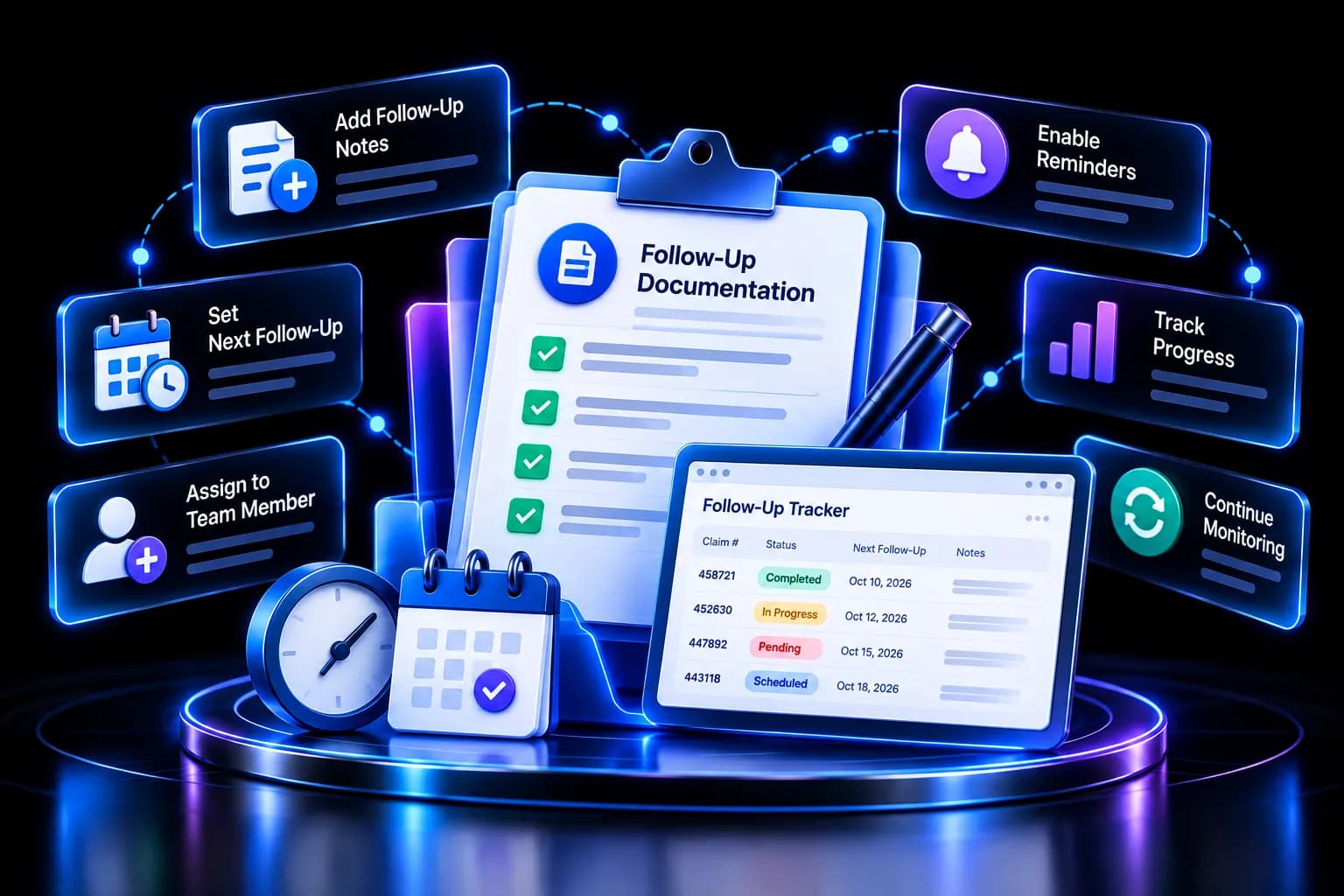
Payer responses, actions taken, unresolved requirements and next follow up points should remain visible so accounts requiring multiple touches retain continuity.
A/R follow-up and denial management are connected but they start with different questions. A/R follow up asks: Why is this amount still outstanding and what should happen next? The claim may be pending, underpaid, missing information, denied or waiting on another action. Denial management asks: Why did the payer deny this claim and what is the appropriate denial specific resolution? That may involve correction, reconsideration, appeal support or another denial workflow.
A/R aging shows how outstanding billed balances are distributed over time. Common buckets include 0–30, 31–60, 61–90, 91–120, and more than 120 days. This helps identify where balances are accumulating and which segments need closer attention. But aging is a prioritization signal, not a diagnosis: two claims in the same bucket can require completely different actions based on payer status and claim history.
Accounts receivable sits within a connected revenue cycle. Insurance verification, prior authorization, medical coding, charge entry, claims processing, denial management, A/R follow-up, and payment posting all affect what ultimately happens to an outstanding balance. The workflow is not consistently linear. An A/R review may uncover a denial that needs denial management, a submission problem that belongs in claims processing, or payment activity that requires payment-posting review. Treating A/R as a routing and follow-up function keeps dependencies visible while maintaining clear ownership of each task.
Elexoft supports medical billing workflows spanning insurance verification, claim submission, denial appeals, patient billing and payment follow up. This connected view keeps outstanding claims in context within the wider billing process. Our A/R approach stresses structured review, aging-based prioritization, payer follow up, claim status visibility, documented follow up steps and coordination with related billing workflows. Practices can discuss focused medical A/R services or broader revenue cycle requirements based on their operations.




Medical accounts receivable services help medical providers manage outstanding billed balances. Services can include A/R aging review, claim status research, insurance follow up, payer communication, account tracking, old A/R review and routing unresolved issues to the appropriate billing workflow.