


500+
Successful Projects

 Loading…
Elexoft provides HIPAA compliant medical coding services for US practices that need an organized way to translate documented patient encounters into appropriate diagnosis, procedure, service and modifier codes before claims move into billing.
Medical coding is not simply selecting a code that appears to match a diagnosis or procedure. The code assigned must be supported by the medical record and appropriate for the documented encounter.That makes documentation central to the coding process.
Elexoft's medical coding workflow starts with the available clinical record, reviews the documented diagnoses and services, applies the relevant coding framework and identifies cases where information may be incomplete or demand clarification.
The objective is to produce coding that accurately reflects what was documented and supports a stronger handoff to charge entry, claim preparation and the rest of the revenue cycle.
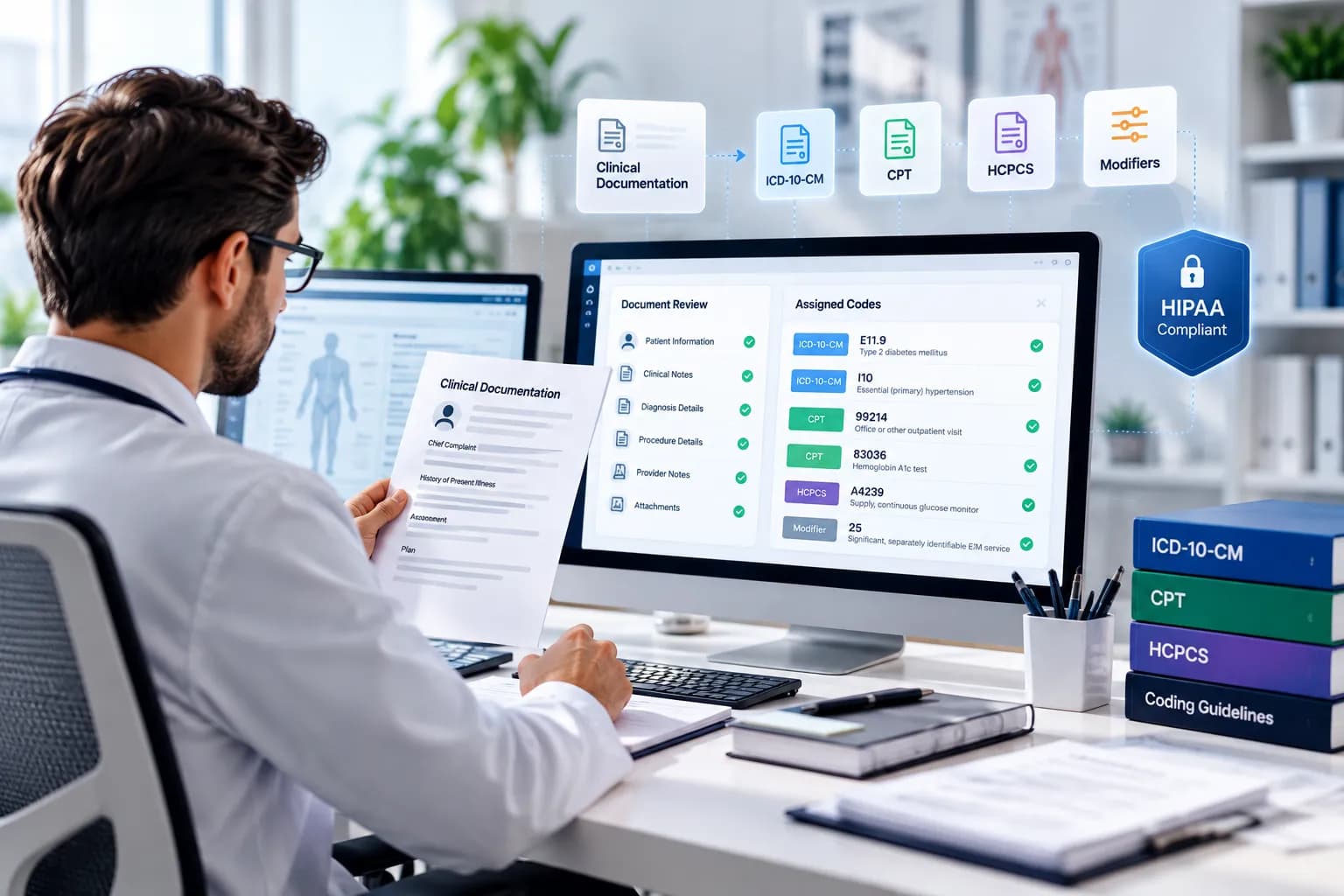



Elexoft supports key medical coding activities from clinical documentation review and code assignment to modifier application and coding clarification, helping practices maintain an organized and consistent coding workflow.
ICD-10-CM codes classify diagnoses, conditions, symptoms and reasons for healthcare encounters.
Our coding workflow reviews the available clinical documentation and assigns applicable diagnosis codes based on what the provider has documented and the relevant coding guidelines.
Specificity matters. The record may contain details about the condition, site, laterality, acuity or other clinical characteristics that affect code selection. When required information is unclear or absent, the appropriate response is clarification not assuming clinical details that are not documented.
Coding support should fit the way your practice already documents care and manages billing.
Elexoft's current medical and dental billing offering supports environments using Dentrix, Eaglesoft, Kareo, Athenahealth and Epic. During onboarding, we can review the coding workflow alongside the practice's documentation process, encounter volume, billing responsibilities and internal handoffs.
The service scope can then be defined around what your team actually needs instead of forcing the practice into a generic coding process.
This is especially important when you add coding to an existing billing operation, because responsibilities between providers, internal staff, coding support and billing teams should remain clear.


The process starts with the documentation available for the patient encounter. We review relevant information to understand the diagnoses, procedures, services and other details documented by the provider.

Elexoft delivers medical coding support as a connected part of the healthcare revenue cycle, with a focus on documentation review, appropriate code assignment, clarification, and an organized handoff into billing.
We review available clinical documentation, apply the appropriate coding framework, and identify questions that require clarification before moving forward.
Medical coding can connect with insurance verification, prior authorization, charge entry, claims processing, payment posting, denial management, accounts receivable, and other billing functions.
Practices can use Elexoft for dedicated medical coding support without outsourcing the entire revenue cycle, or integrate coding into a broader medical billing workflow.

Elexoft can help your practice establish coding support that fits your documentation process, systems, workload and broader revenue cycle operations.
Evaluate the encounter to determine which coding systems and guidelines apply. Depending on the service, this may involve ICD-10-CM diagnosis coding, CPT procedure or professional service coding, HCPCS codes and applicable modifiers.

Select codes based on the documented encounter and applicable coding requirements. The goal is not to choose the highest paying code or the most general code. It is to assign coding that appropriately represents the documented service.

When documentation does not provide enough information to support appropriate code assignment, flag the case for clarification and additional review rather than filling the gap with an assumption.

When included in the service scope, review coding to check consistency with the available documentation and applicable coding requirements before the encounter moves further into the billing workflow.

Once coding is completed, the coded encounter can move into the appropriate charge entry, claim preparation or billing workflow. This keeps coding focused on its core responsibility: creating a clear connection with the next stage of revenue cycle management.




Medical coding services convert documented diagnoses, procedures, and healthcare services into standardized codes used in healthcare records and billing workflows. Depending on the encounter, this may involve ICD-10-CM, CPT, HCPCS, and applicable modifiers.