

Software Development Life Cycle (SDLC): Phases, Steps & Models
 Updated by James Smith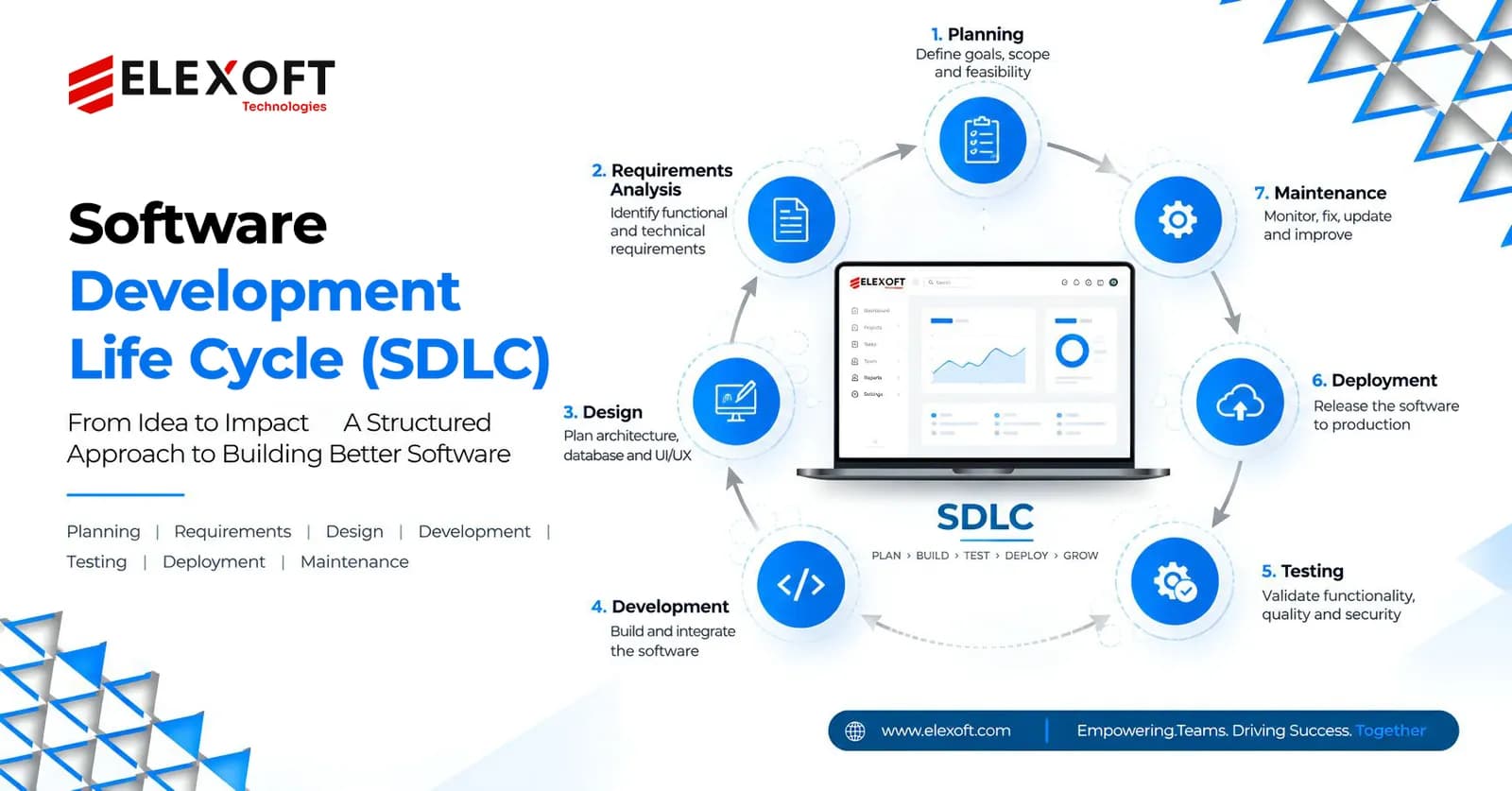
Building software involves much more than writing code. Before development begins, teams need to understand the business problem, define requirements, evaluate technical options, plan the architecture, and determine how the finished product will be tested and delivered.
- After launch, the software still requires monitoring, maintenance, security updates, and continuous improvement.
- The software development life cycle (SDLC) provides an organized framework for managing this entire journey.
- SDLC helps development teams move systematically from an initial idea to a working software product by dividing development into workable phases. These phases typically cover planning, requirements analysis, design, development, testing, deployment, and maintenance.
- However, following the SDLC does not mean every software project follows the same path. Different SDLC models, such as Waterfall, Agile, Spiral, Iterative, and V-Model, organize these activities differently depending on requirements, risk, project complexity, and how frequently feedback or releases are needed.
- This guide explains what SDLC is, its phases, popular software development models, how they differ, how modern development practices affect the lifecycle, and how organizations can choose an approach suited to their projects.
What Is the Software Development Life Cycle (SDLC)?
The software development life cycle (SDLC) is an organized approach for planning, designing, developing, testing, deploying, and maintaining software. It divides software development into defined phases so teams can manage requirements, responsibilities, deliverables, quality, risks, and progress throughout a software project.
Instead of moving directly from an idea into coding, SDLC implements a systematic development process.
For example, before developers begin implementing an e-commerce application, the team needs answers to important questions:
- What business problem should the application solve?
- Who will use it?
- What features are required?
- What technical architecture should support it?
- What security requirements apply?
- How will the software be tested?
- How will it be deployed?
- What happens after launch?
The SDLC supplies a framework for answering these questions at appropriate points in the development process.
Each phase normally has a particular purpose and set of outputs. One phase's output can become another phase's input. Requirements influence design, design guides development, development produces software for testing, and testing helps determine whether the product is ready for deployment.
The exact sequence depends on the development model being used. A Waterfall project may progress through phases largely sequentially, whereas an Agile team can revisit requirements, design, development, and testing repeatedly during short development cycles.
What Does SDLC Stand For?
- SDLC stands for Software Development Life Cycle.
- The term describes the lifecycle through which software progresses, starting with initial planning and requirements to development, release, maintenance, and eventually replacement or retirement.
- You may also encounter the spelling software development lifecycle. Both “life cycle” and “lifecycle” are widely used when discussing SDLC.
Software Development Life Cycle vs. Systems Development Life Cycle
- The software development life cycle and systems development life cycle are closely related terms, but their scope can differ.
- The software development life cycle focuses specifically on developing and maintaining software applications and software systems.
- The systems development life cycle can be broader. Depending on the organization and context, it may address the development of an entire information system, including software, infrastructure, processes, data, users, and other system components.
- The concepts overlap significantly because software development is often an important part of a larger system-development initiative. When the project is specifically about creating software, “software development life cycle” is generally the more precise term.
Why Is SDLC Important?
Software projects involve technical decisions, business requirements, budgets, timelines, security considerations, users, and multiple stakeholders. Without an organized development process, teams may start building before they fully understand what to build.
SDLC provides structure. It establishes defined activities and deliverables throughout development, so teams can make decisions with greater context instead of treating software development as one continuous coding exercise.
Key Benefits of the Software Development Life Cycle
- Clearer Project Direction: Planning and requirements activities establish what the project is expected to accomplish before substantial development work begins. This creates a common understanding among stakeholders, designers, developers, testers, and project managers.
- Better Requirements Management: Documenting and validating requirements reduces ambiguity. Teams can distinguish between essential functionality, optional functionality, technical restrictions, security requirements, and non-functional requirements such as performance and extensibility.
- More Predictable Development: Breaking a complex project into phases makes the work easier to plan and monitor. Teams can establish milestones, dependencies, responsibilities, and deliverables instead of managing the entire project as a single task.
- Earlier Risk Identification: Teams can consider technical, operational, security, schedule, and requirement risks before they become expensive production problems.
- Improved Software Quality: Testing and quality assurance become defined parts of the lifecycle rather than activities performed only when development is almost complete.
- Stronger Collaboration: An SDLC creates common reference points for business stakeholders and technical teams. Requirements documents, designs, prototypes, test plans, and release criteria help teams communicate about concrete deliverables.
- Better Maintainability: The lifecycle continues after deployment. Monitoring, bug fixing, security updates, performance optimization, and feature development are part of maintaining useful software over time.
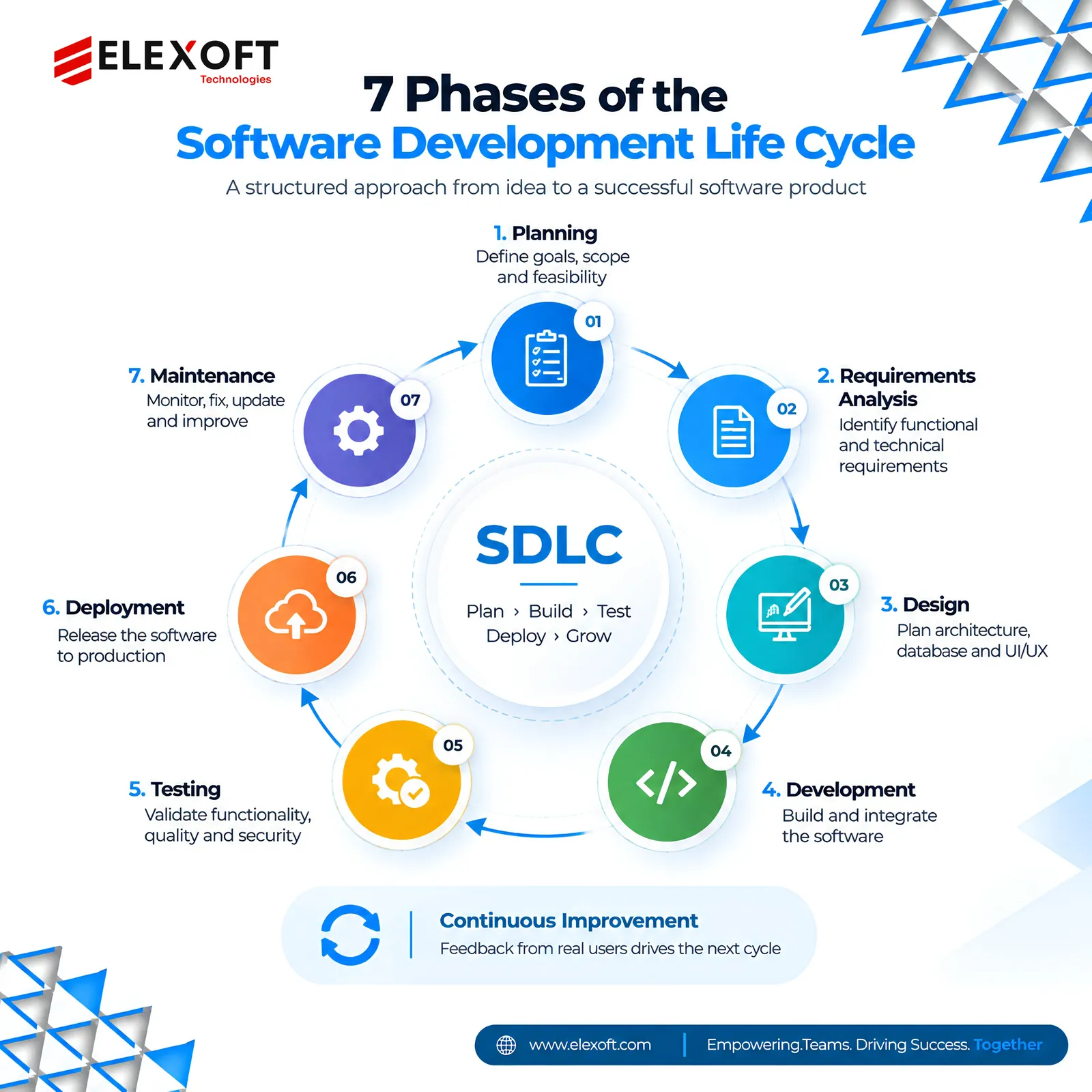
What Are the 7 Phases of SDLC?
Planning → Requirements Analysis → Design → Development → Testing → Deployment → Maintenance
The exact number is not universal. Some methodologies combine planning and requirements, while others separate feasibility, analysis, implementation, operations, or retirement into their own stages.
Using seven phases helps because it provides enough detail to understand the major activities involved without implying that every organization must structure its process the same way.
Let’s examine what happens during each phase.
Planning
Planning establishes the foundation of the software project.
At this stage, stakeholders and project teams define the problem they want to solve, the expected business outcome, the project’s initial scope, major constraints, required resources, and possible risks.
The objective is not to design every screen or technical component. It is to determine whether the proposed project makes sense and define a realistic direction.
Typical planning activities can include:
- defining project objectives
- identifying stakeholders
- establishing preliminary scope
- evaluating feasibility
- identifying major risks
- estimating resources
- considering timelines and budget constraints
- identifying high-level technical requirements
Feasibility can involve several dimensions.
- Technical Feasibility: Technical feasibility asks whether the organization has, or can obtain, the technology and expertise necessary to build the solution.
- Operational Workability: Operational workability considers whether the proposed software will work within the organization’s actual processes and environment.
- Economic Feasibility: Economic feasibility evaluates whether the project's expected value justifies its development and operating costs.
- Schedule Feasibility: Schedule feasibility considers whether the project can realistically be completed within the required timeframe.
A planning phase may produce a project plan, scope definition, feasibility assessment, initial schedule, risk register, or similar project documentation.A common mistake at this stage is beginning development with an attractive product idea but without clearly defining the problem the software needs to solve. That doubt often reappears later as changing requirements and rework.
Requirements Analysis
- Once the team understands the project direction, it needs to determine exactly what the software must do.
- The Requirements Analysis Phase translates business needs and user expectations into requirements that designers, developers, and testers can work with.
- Requirements generally fall into two broad categories.
- Functional requirements describe what the software should do.
For an ecommerce platform, functional requirements might include:
- account registration
- product search
- shopping cart management
- checkout
- online payments
- order tracking
- administrative product management
Non-Functional Requirements
Non-functional requirements describe how the system should operate. These can include expectations related to:
- performance
- security
- availability
- scalability
- accessibility
- reliability
- usability
- maintainability
Requirements gathering may involve stakeholder interviews, workshops, existing system analysis, user research, business process analysis, prototypes, and documentation reviews.
A formal project may capture these requirements in a Software Requirements Specification (SRS) or an equivalent requirements-management system. Agile teams may express requirements through product backlogs, epics, user stories, and acceptance criteria.
The format can change, but the objective stays the same: create a shared, testable understanding of what should be built.
Poor requirements are one of the most damaging sources of rework in software projects. A requirement such as “the application should load quickly” is open to interpretation. A measurable performance requirement gives development and QA teams something specific to design for and verify.
Requirements should therefore be clear, relevant, testable, prioritized, and traceable to actual user or business needs.
System and Software Design
The design phase determines how the requirements will be transformed into a working technical solution. Software architects, UI/UX designers, developers, database specialists, security professionals, and other technical stakeholders may contribute, depending on the project's size and complexity.
Design occurs at multiple levels.
- System Architecture: The team determines how major components of the solution interact. This can include frontend applications, backend services, databases, APIs, third-party integrations, cloud infrastructure, authentication systems, and other services.
- Database Design: Teams determine how information will be structured, stored, accessed, related, and protected.
- UI/UX Design: Designers translate user requirements into user flows, wireframes, prototypes, interfaces, and interaction schemes.
- API and Integration Design: If the software communicates with payment gateways, CRM systems, external APIs, mobile applications, or other services, teams define how these integrations should operate.
- Security Design: Authentication, authorization, encryption, information handling, secrets management, logging, and other security requirements should influence architecture rather than being added only after development.
The design phase may produce architecture diagrams, database schemas, API specifications, prototypes, interface designs, technology decisions, and technical design documents.A strong design creates a technical blueprint while still allowing appropriate latitude during implementation.Over engineering is a risk here. Architecture should reflect actual requirements and realistic future needs, not add complexity simply because a technology or architectural pattern is popular.
Development
The development phase turns approved requirements and designs into working software. Developers write application code, configure databases, implement APIs, build interfaces, integrate third-party services, and connect the components defined during design. However, professional software development involves more than writing code.
Development activities can also include:
- source control
- branching and merging
- code reviews
- automated builds
- unit testing
- dependency management
- coding standards
- technical documentation
- static analysis
- integration work
- Version-control systems: let teams track code changes, collaborate safely, review work, and restore earlier versions when needed.
- Code review: provides another layer of quality control. Developers can identify logic problems, maintainability issues, security concerns, and inconsistencies before changes reach later environments.
- Modern teams: also automate many repetitive development activities through continuous integration pipelines. When developers commit changes, automated processes can build the software, execute tests, perform code-quality checks, and provide rapid feedback.
- In a traditional sequential model: teams may implement much of the software before formal testing begins.
- In Agile and DevOps-oriented environments: development and testing often happen continuously in smaller increments.
The objective remains the same turn approved requirements and designs into software that is functional, maintainable, testable, and ready for validation.
Testing
Software testing verifies whether the developed system behaves as expected and satisfies defined requirements. Testing should not be understood as simply “finding bugs.” It provides evidence about software quality and helps teams identify problems before users encounter them.
Different types of testing answer different questions.
- Unit Testing: Unit testing checks individual functions, methods, or components.
- Integration Testing: Integration testing verifies whether different components and services communicate correctly.
- Functional Testing: Functional testing checks whether features behave as required.
- System Testing: System testing evaluates the integrated application as a complete system.
- Performance Testing: Performance testing examines operation under expected or intense workloads.
- Security Testing: Security testing looks for vulnerabilities and weaknesses that could expose systems or data.
- Regression Testing:Regression testing verifies that new changes have not broken existing functionality.
- User Acceptance Testing (UAT): User acceptance testing (UAT) helps determine whether the system satisfies business and user expectations before final acceptance or release.
When teams discover defects, they document, prioritize, fix, and retest them. Modern development teams increasingly automate repeatable tests and integrate them into CI/CD pipelines. Automation provides faster feedback, particularly for regression tests that need to run frequently. However, automation does not eliminate the need for human decision-making. Exploratory testing, usability evaluation, complex business scenarios, and acceptance testing can still require human involvement.
Testing should also begin conceptually much earlier than this phase. Clear acceptance criteria during requirements analysis and testability evaluations during design reduce ambiguity when formal validation begins.
Deployment
Once the software meets release criteria, deploy it to the production environment. Deployment makes the application or a new version available to actual users.
The process can include:
- creating production builds
- configuring infrastructure
- setting environment variables and secrets
- performing database migrations
- configuring monitoring
- running deployment checks
- releasing application components
- validating production behavior
- preparing rollback procedures
Not every release is deployed in the same way.A team may release the entire application at once, gradually expose a new version to users, maintain parallel environments, or enable features selectively. Modern CI/CD pipelines automate much of this process. Automation makes deployments more repeatable and decreases manual steps that can introduce errors. Deployment is not the end of the software development life cycle. Once software interacts with real users, real traffic, external services, and production data, teams gain information that was impossible to obtain fully in development environments.
That leads directly into maintenance.
Maintenance and Continuous Improvement
After deployment, software enters its running life. The maintenance phase keeps the application secure, reliable, useful, and consistent with changing requirements.
Maintenance activities may include:
- fixing production bugs
- monitoring system health
- improving performance
- applying security patches
- updating dependencies
- adapting to operating system or platform changes
- improving existing features
- launching new functionality
- responding to user feedback
- scaling infrastructure
- addressing newly identified vulnerabilities
Maintenance should not be confused with simply repairing broken software.
Successful applications evolve.
- Customer expectations change. Businesses launch new processes. Third-party APIs change. Security vulnerabilities are discovered. Traffic grows. Regulations may establish new requirements. Technologies eventually become unsupported.
- The lifecycle therefore becomes continuous.
- Feedback from production can generate new requirements, which move through planning, design, development, testing, and deployment again.
- Eventually, software may reach a point where upkeep is no longer practical. Organizations may then modernize, replace, migrate, or retire the system. In lifecycle models that explicitly include retirement, this becomes another formal phase.
SDLC Phases at a Glance
Planning |
Establish project direction |
Scope, feasibility, risks, resources |
Project plan and feasibility assessment |
|
Requirements Analysis |
Define what the software must do |
Gathering and validating requirements |
SRS, backlog, user stories or requirements documentation |
|
Design |
Determine how the system will work |
Architecture, database, UI/UX, APIs |
Technical designs, prototypes and specifications |
|
Development |
Build the software |
Coding, integration, reviews, unit tests |
Working software components |
|
Testing |
Verify quality and requirements |
Functional, integration, performance and security testing |
Validated build and defect reports |
|
Deployment |
Release software |
Production configuration, migration, release |
Production software |
|
Maintenance |
Keep software useful and reliable |
Monitoring, fixes, updates and improvements |
Patches, updates and new releases |
SDLC Diagram
A simplified SDLC diagram can be represented as:
Planning → Requirements → Design → Development → Testing → Deployment → Maintenance → Feedback / New Planning
The arrow back to planning is important. Even when diagrams display SDLC as a straight sequence, real software products frequently continue through additional cycles as users provide feedback and new requirements emerge.
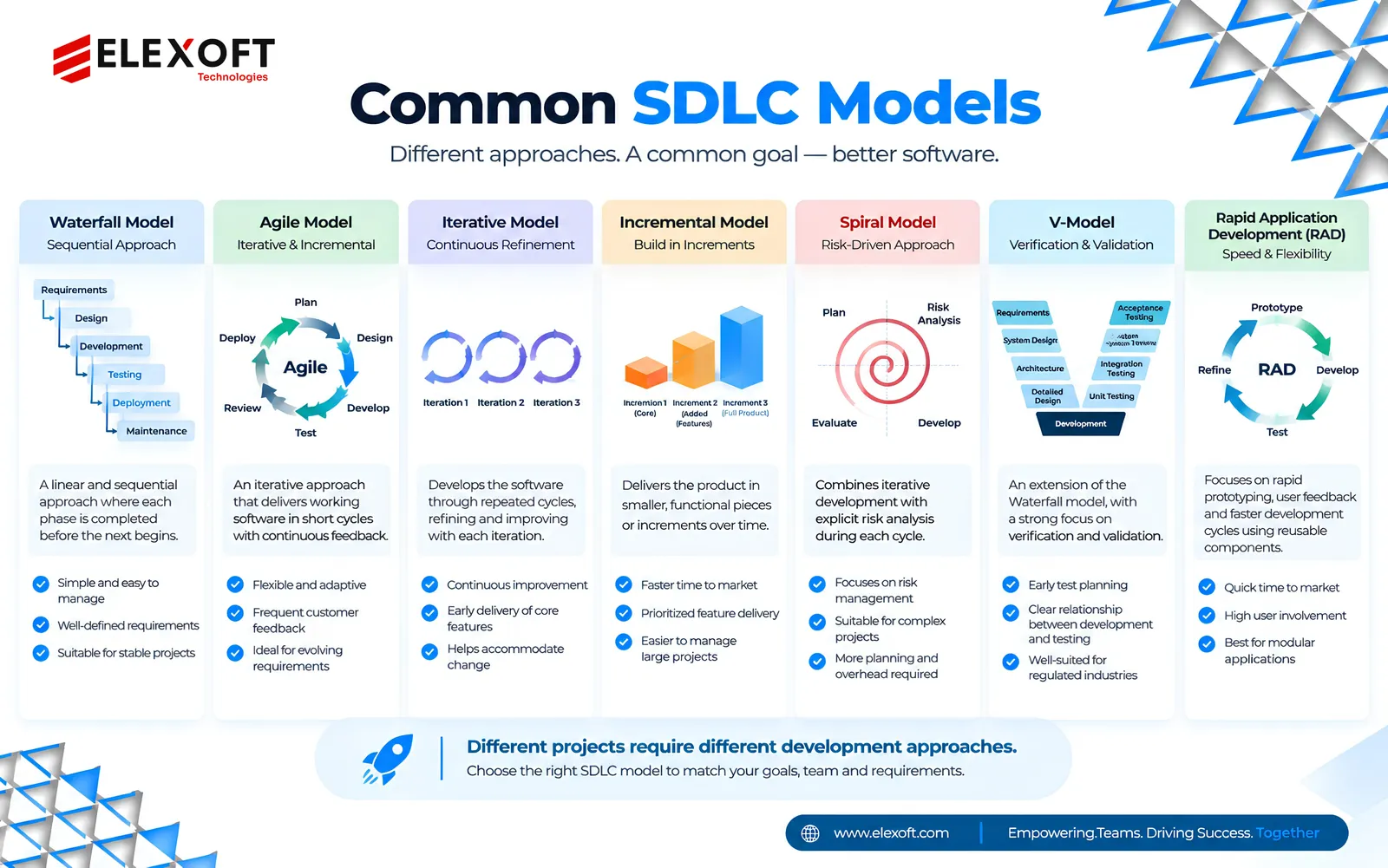
What Are SDLC Models?
SDLC models are approaches for organizing and executing the phases of the software development life cycle. The phases describe what activities need to happen. The model describes how and in what sequence those activities are performed.
This distinction is important. Planning, requirements, design, development, testing, deployment, and maintenance can exist across many projects, but a Waterfall project handles their relationship differently from an Agile or Iterative project.No single software development model fits every project. Requirements stability, risk, regulatory limitations, team structure, project size, customer involvement, and desired release frequency may all influence the choice.
Waterfall Model
- The Waterfall model organizes software development into a largely sequential progression.
- A phase is substantially completed before the project moves into the next one: Requirements → Design → Development → Testing → Deployment → Maintenance
- This creates a predictable structure and strongly emphasizes upfront planning and documentation.
- Waterfall can be appropriate when requirements are stable, well understood, and unlikely to change substantially.
- Its major limitation is flexibility.
- If users discover late in development that an important requirement was misunderstood, returning to earlier decisions can entail substantial rework.
- Waterfall therefore tends to fit projects with clearly defined requirements better than products where continuous experimentation and changing customer expectations are central to development.
Agile Model
- Agile software development takes an iterative and incremental approach.
- Instead of defining and building the complete product in one long sequence, teams divide development into smaller increments and repeatedly plan, build, test, review, and improve the product.
- Work is often organized into short development cycles or sprints.
- Feedback can therefore influence the product throughout development rather than arriving only after the team builds a complete system.
- Agile works particularly well when requirements are expected to evolve or when teams need frequent feedback from users and stakeholders.
- Agile does not remove planning, requirements, design, or testing. It changes how frequently these activities occur.
- Rather than performing each activity once, teams can perform them repeatedly for smaller portions of the product.
Iterative Model
- The Iterative model develops software through repeated versions.
- Teams begin with an initial implementation and progressively refine it through subsequent iterations.
- Each iteration can reveal new requirements, usability concerns, technical limitations, or opportunities for improvement.
- This approach is valuable when the overall objective is understood, but all detailed requirements cannot be confidently defined at the beginning.
- The iterative model reduces the need to make every product decision upfront.
- Its success, however, depends on disciplined feedback and architecture. Repeatedly modifying software without managing technical debt can make later iterations increasingly difficult.
Incremental Model
- The Incremental model divides the system into functional pieces that are delivered over time.
- Instead of waiting until the entire system is complete, teams release usable portions of functionality incrementally.
- For example, an e-commerce platform might deliver account management first, then catalog functionality, followed by checkout, payment, and analytics capabilities.
- Incremental development delivers useful functionality earlier and makes large projects easier to manage.
- It is frequently combined with iterative practices: increments add functionality while iterations improve existing functionality.
Spiral Model
- The Spiral model combines iterative development with explicit risk analysis.
- Development progresses through repeated cycles, or spirals, with each cycle considering objectives, risks, development activities, and evaluation.
- Risk management is a defining characteristic.
- The model can therefore be useful for large, complex, expensive, or high-risk projects where technical uncertainty needs to be evaluated continuously.
- Its downside is complexity. Effective risk analysis requires expertise and can introduce management overhead that is unnecessary for smaller or straightforward applications.
V-Model
- The V-Model, or Verification and Validation model, focuses on the relationship between development stages and corresponding testing activities.
- Requirements and design activities form one side of the “V,” implementation sits near the bottom, and associated testing and validation activities form the other side.
- For example, system requirements can correspond to acceptance testing, while detailed designs can correspond to lower-level testing activities.
- This structure encourages teams to think about validation early rather than postponing all test planning until development is complete.
- The V-Model can be useful when requirements are well defined, and strong verification and documentation are important.
- Like Waterfall, however, it can be less flexible when requirements change frequently.
Rapid Application Development (RAD)
- Rapid Application Development (RAD) emphasizes rapid prototyping, user feedback, reusable components, and shorter development cycles.
- Instead of spending extensive time defining every requirement before users see the system, teams build prototypes or working components and improve them based on feedback.
- RAD works well when speed and user interaction matter and the system can be divided into workable modules.
- It depends heavily on stakeholder access and the ability to make quick decisions. It can be less appropriate when architecture is extremely complex or extensive formal controls are required.
DevOps
DevOps combines development and operations practices to improve collaboration and automate the path from code creation to deployment and operation. DevOps is broader than a traditional SDLC model, but it strongly influences how modern organizations execute the software lifecycle.
Practices commonly associated with DevOps include:
- continuous integration
- continuous delivery or deployment
- infrastructure automation
- automated testing
- monitoring and observability
- close development and operations collaboration
Instead of treating deployment and operations as activities that occur after development is finished, DevOps creates continuous feedback between development and production. This makes the lifecycle faster and more operationally connected.
SDLC Models Comparison
SDLC Model | Development Approach | Flexibility | Stakeholder Involvement | Best Suited For |
|---|---|---|---|---|
Waterfall | Sequential | Lower | Lower | Stable, clearly defined requirements |
Agile | Iterative and incremental | High | High | Products with evolving requirements |
Iterative | Repeated refinement | High | High | Solutions requiring learning and refinement |
Incremental | Functionality delivered in pieces | High | Regular | Large products that can be modularized |
Spiral | Iterative and risk-driven | High | Regular | Complex or high-risk projects |
V-Model | Sequential with paired verification | Lower | Structured | Projects requiring strong validation |
RAD | Rapid prototypes and feedback | High | Very high | Time-sensitive, modular applications |
DevOps | Continuous development and operations | High | Continuous | Products requiring frequent, reliable releases |
The table should be used as general guidance rather than a strict selection rule. In practice, many projects combine principles and practices from multiple SDLC approaches.
How to Choose the Right SDLC Model
Choosing an SDLC model is not about finding the universally “best” methodology. The right model depends on the project's characteristics.
Numerous factors deserve consideration.
- Requirement Stability: If requirements are fixed and thoroughly documented, a sequential development model may be practical. If requirements are expected to evolve based on user interaction and feedback, an iterative or Agile approach generally provides greater flexibility
- Project Complexity: A simple internal application and a large distributed enterprise platform have significantly different architecture, scalability, integration, and coordination requirements.
- Risk: Projects involving significant technical, financial, security, or operational uncertainty may benefit from development approaches that explicitly address risk and support early validation.
- Stakeholder Availability: Agile and RAD depend heavily on frequent stakeholder feedback. If stakeholders are unable to participate consistently, teams should plan for this limitation and adjust the development process accordingly.
- Release Frequency: A product that releases improvements weekly has different lifecycle requirements from a system that is updated or released less frequently.
- Compliance and Documentation: Some environments require extensive traceability, validation, approvals, and formal documentation. The selected development approach should support these compliance and documentation requirements.
- Team Structure: Distributed teams, specialized engineering groups, cross-functional product teams, and external development partners may each require different coordination and collaboration practices.
- Technical Uncertainty: When a project depends on unfamiliar technologies or architecture, prototypes and iterative validation can reduce the risk of discovering basic limitations too late. Many organizations ultimately use mixed approaches rather than applying one model exactly as described in textbooks.
SDLC vs Agile: What Is the Difference?
SDLC and Agile are not competing concepts. SDLC defines the overall software development lifecycle, while Agile is an approach used to manage and execute activities within that lifecycle.
This distinction is frequently misunderstood. SDLC answers the wider question: What Activities Are Necessary to Take Software from an Idea Through Development, Deployment, and Maintenance?
Agile focuses on how teams organize and execute work through short development cycles, close collaboration, incremental delivery, and frequent stakeholder feedback.
|
Describes the overall software lifecycle |
Provides an iterative development approach |
|
Includes planning through maintenance |
Repeats development activities in shorter cycles |
|
Can use different models |
Is one approach used within SDLC |
|
Applies broadly to software projects |
Particularly useful where change and feedback are frequent |
- An Agile team still performs planning.
- It still gathers requirements.
- It still designs, develops, tests, deploys, and maintains software.
- The difference is that these activities repeat rather than being completed once in a strict sequence.
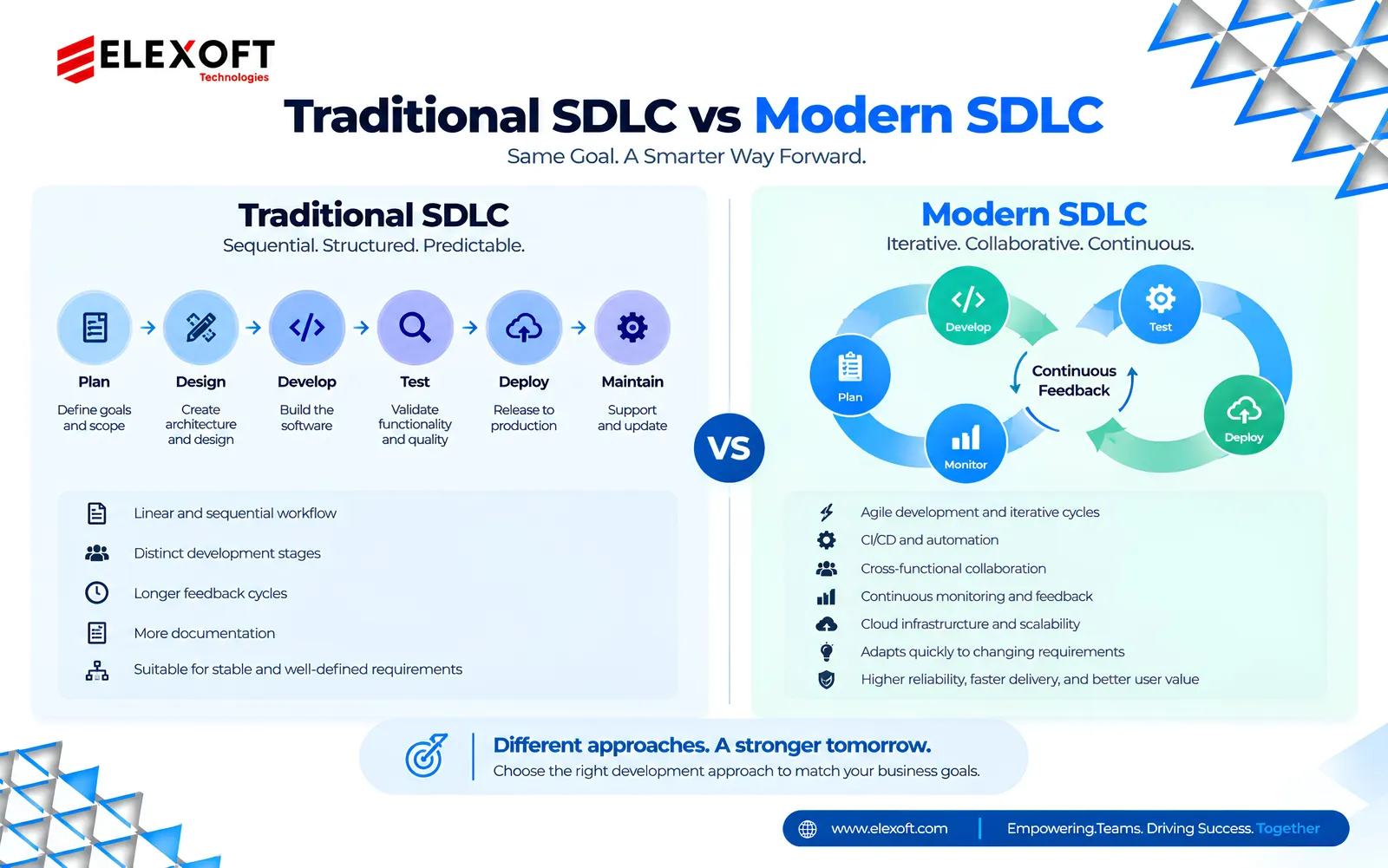
Traditional SDLC vs Modern SDLC :
The fundamental purpose of SDLC has not disappeared, but the way development teams execute the lifecycle has changed significantly.
Traditional software development often separated major activities into distinct departments and phases. Modern development increasingly connects them through automation, shared tooling, cross-departmental teams, and continuous feedback.
Agile Development
- Agile reduces the size of development cycles.
- Instead of waiting months for stakeholders to evaluate an entire application, teams can deliver smaller increments, gather feedback, and modify priorities.
- This makes requirements management more continuous.
DevOps and CI/CD
- DevOps connects development with deployment and operations.
- Continuous integration (CI) allows developers to integrate changes frequently and validate them through automated builds and tests.
- Continuous delivery (CD) prepares validated software changes for reliable release.
- Some organizations extend this to continuous deployment, where changes that meet defined criteria can automatically move into production.
- CI/CD does not eliminate SDLC phases. It automates and connects activities that once demanded considerable manual coordination.
Automated Testing
- Automation lets teams run repeatable tests whenever software changes.
- This can shorten feedback cycles and help identify regressions before changes move further through the delivery pipeline.
- The right balance between automated and manual testing depends on the system type and the risks being evaluated.
Cloud Infrastructure
- Cloud platforms allow teams to provision development, testing, and production infrastructure programmatically.
- Infrastructure as code can make environments more consistent and repeatable, while cloud services can simplify scaling, monitoring, deployment, and disaster recovery.
- Architecture decisions still need to account for cost, security, reliability, data requirements, and vendor dependencies.
AI-Assisted Software Development
- AI-assisted development tools are increasingly being used for activities such as code suggestions, documentation assistance, test generation, code explanation, and developer productivity workflows. Their use does not remove the need for an SDLC.
- AI-generated or AI-assisted outputs still need appropriate requirements, architecture, review, testing, security controls, and human monitoring. In that sense, AI changes some of the tools used inside the lifecycle rather than eliminating the lifecycle itself.
Continuous Monitoring and Feedback
Modern development broadens feedback beyond pre-release testing.
Production monitoring can reveal:
- errors
- performance degradation
- infrastructure problems
- unusual behavior
- adoption patterns
- operational bottlenecks
That information feeds back into planning and development, supporting the idea that the SDLC is a lifecycle, not a one-way production line.
What Is a Secure Software Development Life Cycle (SSDLC)?
A Secure Software Development Life Cycle (SSDLC) integrates security practices throughout software development rather than treating security as a final test before deployment.
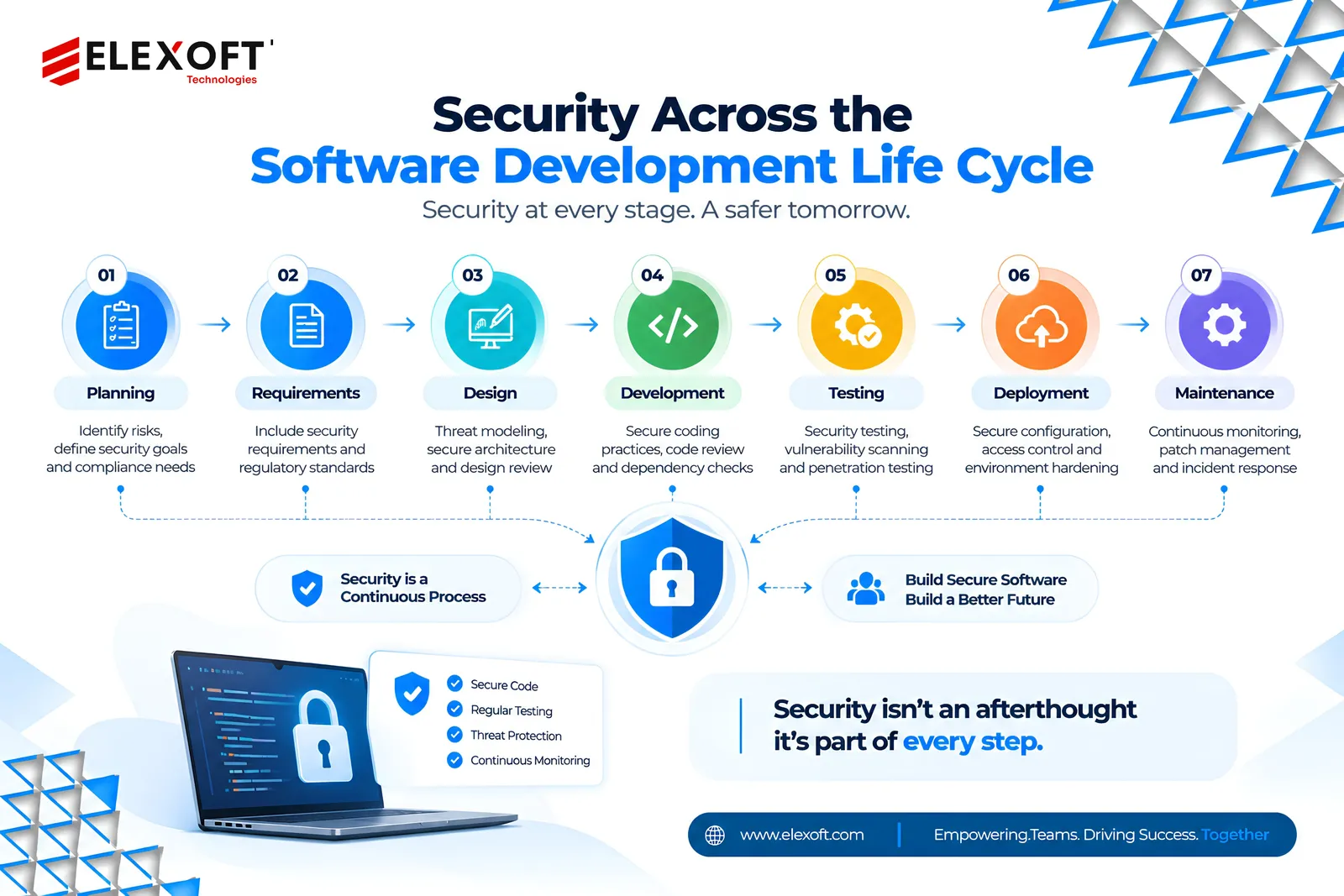
Security decisions made early in development can influence requirements, architecture, implementation, testing, deployment, and maintenance.
For example:
- Planning: identify security and compliance risks.
- Requirements: define authentication, authorization, privacy, data protection, and other security requirements.
- Design: apply secure architecture principles and perform threat modeling where appropriate.
- Development: follow secure programming practices, manage dependencies, protect secrets, and review code.
- Testing: perform security testing appropriate to the application’s risk profile.
- Deployment: securely configure infrastructure, access controls, credentials, and production environments.
- Maintenance: monitor vulnerabilities, update dependencies, apply patches, and respond to newly discovered risks.
Security matters because vulnerabilities introduced early in development can persist into production if teams rely only on late-stage testing. Modern strategies frequently refer to DevSecOps, which integrates security practices into DevOps workflows and automated delivery pipelines. The principle is clear: security should be part of software engineering decisions throughout the lifecycle, not an isolated checkpoint at the end.
Common SDLC Challenges
A defined lifecycle improves structure, but it does not guarantee project success.
Teams still need to manage several common problems.
Unclear or Incomplete Requirements
Ambiguous requirements cause different stakeholders to develop different expectations about the same feature.
The solution is not simply producing more documentation. Requirements need to be clear, testable, prioritized, and validated with the people who understand the business and users.
- Scope Creep: Projects can gradually accumulate additional requirements without adjusting resources, timelines, or priorities.Change is normal, especially in iterative development, but it needs deliberate management.
- Poor Stakeholder Interaction: Business teams, designers, developers, QA engineers, and operations teams often view a project from different perspectives. Regular communication and clearly defined acceptance criteria reduce the risk of discovering major expectation gaps late in development.
- Inadequate Testing: Compressing testing to recover time lost earlier in a project can create substantial production risk. Plan testing as part of development rather than treating it as optional work after coding.
- Security Added Too Late: Security problems can originate in requirements and architecture, not only in code. Waiting until the final testing stage can make fundamental issues expensive to correct.
- Technical Debt: Short-term implementation decisions can create long-term maintenance costs. Some technical debt is intentional and manageable. Uncontrolled technical debt slows future development and increases risk. Teams should document significant compromises and allocate time for necessary refactoring and modernization.
- Weak Post-Launch Planning: Launching software without monitoring, support responsibilities, backup procedures, incident handling, or an update strategy leaves an important part of the lifecycle undefined.
Production is where software begins serving its actual purpose, not where engineering responsibility automatically ends.
SDLC Best Practices
Effective SDLC implementation depends less on following a diagram perfectly and more on maintaining disciplined development practices. (Moyo, 2022)
- Define the problem before defining the solution. A technically impressive application provides little value if it solves the wrong problem.
- Make requirements testable. Clear acceptance criteria reduce disagreements between development and business stakeholders.
- Involve relevant parties early. Technical, business, security, design, operations, and user perspectives can reveal constraints a single team might miss.
- Design for actual requirements. Avoid both under-engineering and unnecessary architectural complexity.
- Use version control and code review. Changes should be traceable and reviewable.
- Automate repeatable quality checks. Builds, tests, code-quality checks, and deployment operations can often be automated.
- Integrate security throughout development. Security requirements, secure design, programming practices, testing, and vulnerability management should form part of the lifecycle.
- Maintain useful documentation. Documentation should support development and maintenance rather than exist only to satisfy a process.
- Monitor production systems. Logs, metrics, traces, alerts, and user feedback provide information for future improvements.
- Treat maintenance as development. Changes and upgrades should follow appropriate planning, testing, security, and release practices, in the same way as the initial product.
Software Development Life Cycle Example
Consider a business that wants to build an e-commerce application. The following simplified example demonstrates how the software development life cycle connects an idea to an operational product.
Planning
- The company identifies a business objective: allow customers to browse products and place orders online.
- The project team defines initial scope, stakeholders, expected integrations, major constraints, risks, and available resources.
- The initial scope may include a web storefront, customer accounts, product management, checkout, payment processing, and order management.
Requirements Analysis
The team interviews stakeholders and converts business expectations as detailed requirements.
A customer needs to:
- create an account
- browse and search products
- add products to a cart
- complete checkout
- pay securely
- view order status
Administrators need to manage products, inventory, orders, and customers.
The team also defines non-functional requirements related to performance, security, accessibility, availability, and expandability.
Design
- UI/UX designers create customer journeys, wireframes, and interfaces.
- Software architects define the application’s frontend, backend, database, APIs, authentication approach, payment integration, hosting infrastructure, and security controls.
- The database design establishes relationships among products, customers, orders, inventory, and payments.
Development
- Developers implement the frontend and backend functionality.
- They create APIs, database logic, authentication, product management, cart functionality, checkout workflows, payment integration, and administrative features.
- Code is stored in version control and reviewed as features are completed.
Testing
- QA engineers verify functionality across supported devices and browsers.
- Testing covers account creation, product search, carts, checkout, payment behavior, inventory updates, order processing, security, and performance.
- Defects are returned to development for correction and retesting.
Deployment
- After the release criteria are met, the team deploys the application to production.
- The team configures production infrastructure, databases, monitoring, security controls, and integrations.
- Deployment checks verify that the production system operates as expected.
Maintenance
- After launch, the team monitors application health and user feedback.
- Developers fix defects, update dependencies, improve performance, repair security vulnerabilities, and develop additional features.
- Suppose customers later request wish lists.
- That requirement starts another development cycle: Requirement → Design → Development → Testing → Deployment → Maintenance
How Elexoft Approaches Software Development
Elexoft applies a structured development process that moves projects from requirements and design through development, quality assurance, deployment, and ongoing support.
- The process starts with requirement discovery, where business goals, project requirements, user needs, and the initial roadmap are defined. This provides the context needed before technical implementation starts.
- During UI/UX design, the team translates requirements into user journeys and interfaces that define how people will interact with the product.
- The development stage turns approved requirements and designs into working frontend, backend, database, API, and integration components founded on the project's needs.
- Testing and quality assurance then validate functionality, performance, and expected behavior before release issues identified during testing return to development for correction and verification.
- Once the software meets release requirements, it moves through deployment into its production environment.
- After launch, the lifecycle continues through monitoring and support, where performance, technical issues, maintenance needs, and opportunities for improvement feed into future development cycles.
- The exact workflow can vary by project requirements, yet clear requirements, design decisions, testing, deployment controls, and post-launch feedback help keep software development organized throughout the product lifecycle.
Frequently Asked Questions About SDLC
SDLC is an organized process for planning, designing, developing, testing, deploying, and maintaining software. It divides software development into controllable phases with defined objectives and deliverables, helping development teams organize work and maintain quality throughout a software product’s lifecycle.
What does SDLC stand for?
SDLC stands for Software Development Life Cycle. It describes the stages through which software progresses from early planning and requirements through development, deployment, maintenance, and eventually replacement or retirement.
What are the 7 phases of SDLC?
The seven commonly used SDLC phases are planning, requirements analysis, design, development, testing, deployment, and maintenance. The exact number and names can vary because organizations and methodologies sometimes combine or separate activities differently.
What is the first phase of SDLC?
Planning is commonly treated as the first SDLC phase. During planning, teams establish the project’s objectives, scope, feasibility, resources, major risks, stakeholders, and initial timeline before moving toward detailed requirements and design.
What is the longest phase of SDLC?
There is no universally longest SDLC phase. Its duration depends on the project and development model. Development may consume substantial effort during initial implementation, while maintenance can last for years after release and therefore become the longest stage across the software’s total operational life.
What is the difference between SDLC phases and SDLC models?
SDLC phases describe the activities involved in developing software, while SDLC models describe how those activities are organized and executed. Planning, design, development, testing, and maintenance are phases; Waterfall, Agile, Spiral, Iterative, and V-Model are approaches for organizing lifecycle work.
What are the most common SDLC models?
Common SDLC models include Waterfall, Agile, Iterative, Incremental, Spiral, V-Model, and Rapid Application Development. DevOps also strongly influences modern SDLC implementation by connecting development, deployment, operations, automation, and continuous feedback.
Is Agile part of SDLC?
Yes. Agile can be used as an approach for executing activities within the software development life cycle. Agile teams still plan, define requirements, design, develop, test, deploy, and maintain software, but they perform many of these activities repeatedly in short development cycles.
Is SDLC the same as Waterfall?
No. SDLC describes the overall lifecycle of software development, while Waterfall is one model for organizing SDLC activities. SDLC can also be implemented through Agile, Iterative, Spiral, V-Model, Incremental, and other approaches.
What is the difference between SDLC and STLC?
SDLC covers the complete software development lifecycle, while the Software Testing Life Cycle (STLC) focuses specifically on testing activities. STLC can include test planning, test case development, environment setup, execution, defect management, and test closure within the wider software lifecycle.
Which SDLC model is best?
There is no single SDLC model that is best for every project. The appropriate approach relies on factors such as requirement stability, project complexity, risk, stakeholder involvement, documentation needs, team structure, and desired release frequency.
What is Secure SDLC?
Secure SDLC integrates security practices throughout software development. It incorporates security requirements, threat considerations, secure design, secure coding, security testing, deployment controls, vulnerability management, and maintenance across the lifecycle rather than postponing them until final testing.
What is an SDLC diagram?
An SDLC diagram depicts the stages of the software development life cycle. A common version shows Planning → Requirements → Design → Development → Testing → Deployment → Maintenance, often with a feedback loop connecting maintenance and new requirements back to planning.
Why is SDLC important in software engineering?
SDLC gives software teams a structured way to manage requirements, design decisions, development, testing, releases, risks, and maintenance. It clarifies responsibilities and deliverables and helps teams keep aligned between business requirements and technical implementation.
Conclusion
The software development life cycle provides an organized framework for turning a software idea into a maintained, operational product.
Its commonly described phases planning, requirements analysis, design, development, testing, deployment, and maintenance help teams understand what needs to happen throughout software development. SDLC models such as Waterfall, Agile, Iterative, Spiral, and V-Model determine how teams organize those activities.
Contemporary software development has made the lifecycle more continuous through Agile practices, DevOps, CI/CD, automation, cloud infrastructure, and integrated security. The underlying principle remains the same: successful software requires more than code. It requires a repeatable process to understand requirements, make technical decisions, validate quality, manage risk, deliver software, and improve it over time.