

Cyber Security Solutions: Types, Benefits & Implementation
 Updated by James Smith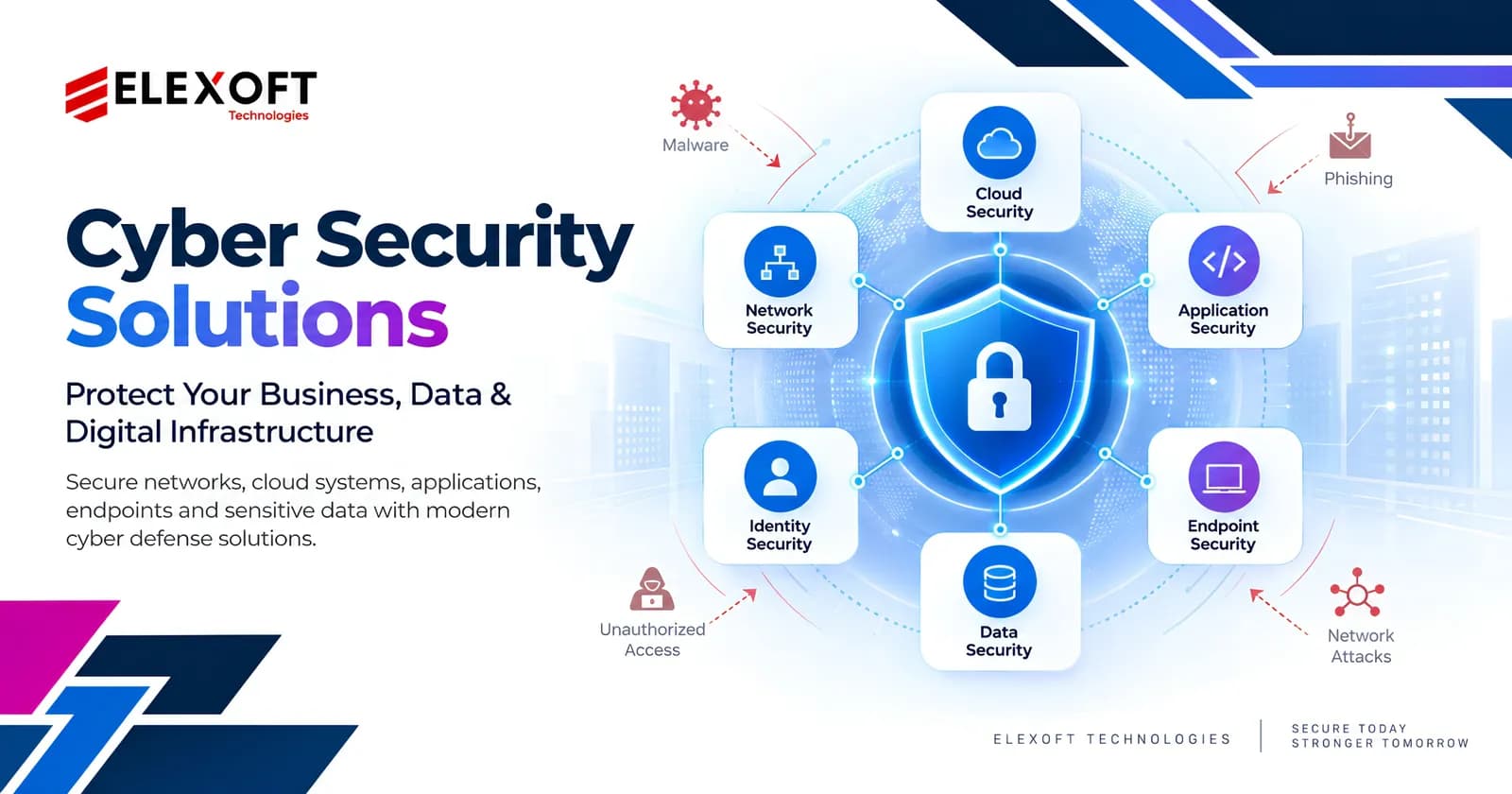
Cyber security solutions are the technologies, processes, controls, and services organizations use to protect networks, applications, devices, cloud environments, accounts, and sensitive data from cyber attacks. They help businesses prevent attacks where possible, detect suspicious activity, respond to incidents, recover from disruption, and continuously improve their security posture.
There is no single security product that protects an organization from every threat. A business may need network security solutions to control traffic, endpoint protection for employee devices, cloud security solutions for cloud workloads, application security solutions for software, identity controls for user access, and monitoring tools to detect suspicious activity.
The right combination depends on the organization’s infrastructure, data, users, applications, regulatory requirements, threat exposure, budget, and business priorities. This guide explains the major types of cyber security solutions, the threats they address, their business benefits, how small businesses could give priority to security, and how organizations are able to implement cybersecurity in a structured way.
What Are Cyber Security Solutions?
Cyber security solutions are safeguards designed to reduce cybersecurity risk across an organization’s digital environment. They can include software products, security platforms, infrastructure controls, policies, monitoring systems, professional services, and operational processes.
Their purpose goes beyond stopping malware. Modern cybersecurity must address risks across users, identities, endpoints, networks, applications, APIs, cloud environments, databases, third-party integrations, and other technology assets.
A useful way to understand cybersecurity is through risk management rather than individual security products. The NIST Cybersecurity Framework 2.0 organizes cybersecurity risk management around six functions: Govern, Identify, Protect, Detect, Respond, and Recover. Together, these functions cover how organizations establish security oversight, understand risks, apply safeguards, identify incidents, respond, and restore affected operations.
This is important because buying a firewall, antivirus platform, or monitoring tool does not automatically create a complete cybersecurity program. Security controls need to work together and correspond to the organization’s actual risks.
Cyber Security Solutions vs Cybersecurity Services
Cyber security solutions and cybersecurity services overlap, but they are not identical.
A cyber security solution may be a technology or control such as a firewall, endpoint detection and response platform, multi-factor authentication system, web application firewall, data loss prevention system, or cloud security platform. Cybersecurity services usually involve people and expertise. Examples include vulnerability assessment, penetration testing, managed detection and response, security monitoring, incident response, cybersecurity consulting, and managed security services.
Many organizations use both. Technology provides protection and visibility, while security professionals configure, monitor, test, investigate, and improve those controls.
Why Do Businesses Need Cyber Security Solutions?
Businesses increasingly depend on interconnected software, cloud platforms, mobile devices, websites, APIs, databases, email, remote access, and third-party systems. Every additional digital asset or connection can introduce security considerations.
Cyber attacks can target organizations through phishing, stolen credentials, vulnerable software, misconfigured cloud services, malware, ransomware, exposed applications, compromised endpoints, malicious insiders, or flaws in third-party systems.
Effective cybersecurity solutions help organizations reduce these threats by creating multiple layers of protection.
They can help a business:
- Secure sensitive and business critical information.
- Control access to systems and applications.
- Reduce exposure to known vulnerabilities.
- Detect suspicious network and endpoint activity.
- Protect public-facing websites and applications.
- Improve visibility across cloud and on premises infrastructure.
- Respond to incidents more systematically.
- Support regulatory and contractual security requirements.
- Reduce operational disruption caused by security incidents.
- Build security into software and infrastructure from the beginning.
The goal is not to eliminate every possible cyber risk. No organization can guarantee that. The goal is to understand risk, prioritize it, implement appropriate controls, detect problems early, and maintain the ability to respond and recover.
What Are the Main Types of Cyber Security Solutions?
Cybersecurity is most effective when different controls protect different layers of the technology environment. The right combination varies by organization, but the following categories cover many of the major areas businesses need to consider.
1. Network Security Solutions
Network security solutions protect the infrastructure that users, devices, applications, and systems use to communicate. They help control network access, inspect traffic, spot suspicious behavior, and reduce unauthorized movement through the environment.
Common network security technologies include:
- Firewalls
- Next generation firewalls
- Intrusion detection systems (IDS)
- Intrusion prevention systems (IPS)
- Network segmentation
- Virtual private networks (VPNs)
- Network access control
- DNS security
- Secure gateways
- Network monitoring
- Zero Trust network access
A firewall, for example, applies rules governing which network traffic is permitted or blocked. IDS technologies focus on detecting suspicious activity, while IPS technologies can take action to prevent identified malicious traffic. Network segmentation provides another important layer. Instead of letting every device or system communicate freely, organizations can separate environments by business function, sensitivity, or trust level. This limits unnecessary access and makes it harder for an attacker who compromises one part of the network to reach other critical resources.
2. Endpoint Security Solutions
Endpoints include laptops, desktops, servers, smartphones, and other devices connecting to business systems.
Conventional antivirus software remains one layer of endpoint protection, but modern environments frequently require broader visibility and response abilities.
Endpoint security may include:
- Anti-malware protection
- Endpoint detection and response (EDR)
- Device encryption
- Host based firewalls
- Application control
- Patch management
- Device management
- Behavioral threat detection
- Extended detection and response (XDR)
EDR solutions continuously collect and analyze endpoint activity to identify potentially malicious behavior and support investigation and response. Endpoint security is especially important when employees work remotely, use portable devices, or connect to company resources outside a traditional office network.
3. Cloud Security Solutions
Cloud computing changes where applications, workloads, identities, and data are hosted, but it does not remove the organization’s responsibility for security.Cloud security solutions help businesses manage security risks across cloud infrastructure, platforms, applications, workloads, identities, and configurations.
Common capabilities include:
- Cloud security posture management (CSPM)
- Cloud workload protection
- Identity and access controls
- Encryption
- Configuration monitoring
- Cloud activity monitoring
- Secrets management
- Vulnerability management
- Data security
- Cloud-native threat detection
CSPM tools are particularly useful for identifying configuration weaknesses and policy deviations across cloud environments.
Cloud security should also account for the shared responsibility model of the relevant cloud provider. The provider secures specific parts of the underlying cloud infrastructure, while customers remain responsible for other areas such as identities, data, configurations, workloads, and applications according to the service being used.
As businesses adopt hybrid and multi cloud architectures, consistent policies and centralized visibility become increasingly important.
4. Application Security Solutions
Application security solutions protect software throughout development, deployment, and operation.Applications can introduce vulnerabilities through insecure code, weak authentication, vulnerable dependencies, poor configuration, exposed APIs, authorization failures, or other implementation weaknesses.
Application security can include:
- Secure programming practices
- Code review
- Static application security testing
- Dynamic application security testing
- Software composition analysis
- Dependency scanning
- Secrets scanning
- API security testing
- Penetration testing
- Runtime protection
- Threat modeling
Application security works best when security is integrated into the development lifecycle rather than added immediately before release.
The OWASP Developer Guide on Secure Development recommends building security activities into SDLC phases rather than treating security as a separate process. This can include security requirements, design considerations, implementation controls, and verification activities.
Organizations building custom digital products should therefore consider security alongside architecture, development, testing, deployment, and maintenance.
Elexoft’s web development services cover custom web applications and related development capabilities, while its wider software development services include web, mobile, AI, and enterprise software development.
5. Web Application Security Solutions
Web applications are continuously exposed to internet traffic, which makes them an important security boundary.
Web application security solutions can include:
- Web application firewalls (WAF)
- Secure authentication
- Authorization controls
- Input validation
- API security
- Bot management
- DDoS protection
- Vulnerability scanning
- Penetration testing
- Secure session management
- Application monitoring
A WAF can inspect HTTP traffic and apply rules designed to block certain malicious requests, but it should not be treated as a substitute for secure application design and development.Security needs to exist at multiple levels: infrastructure, application architecture, source code, dependencies, identity, data, configuration, testing, and monitoring.
6. Data Security and DLP Solutions
Data is often one of an organization’s most valuable digital assets.Data security solutions are designed to protect information from unauthorized access, modification, disclosure, destruction, or loss.
Controls can include:
- Encryption at rest
- Encryption in transit
- Access controls
- Data classification
- Data loss prevention (DLP)
- Backup and recovery
- Database monitoring
- Tokenization
- Rights management
- Key management
DLP solutions help organizations identify sensitive information and apply policies governing how it can be stored, transmitted, copied, or shared. However, effective data security starts with understanding the data itself. An organization that does not know what sensitive information it holds, where that information resides, and who can access it will find it difficult to apply appropriate protection.
7. Identity and Access Management
Modern security increasingly focuses on identity. Employees, administrators, customers, contractors, applications, APIs, and automated systems may all require access to organizational resources. Identity and access management (IAM) helps ensure that the right identity receives appropriate access to the right resource.
Important IAM capabilities include:
- Multi factor authentication (MFA)
- Single sign-on
- Role oriented access control
- Identity lifecycle management
- Conditional access
- Privileged access management (PAM)
- Password policies
- Access reviews
MFA adds an additional verification requirement beyond a password. PAM solutions focus specifically on high privilege accounts, which can have extensive access to sensitive infrastructure and data. The concept of least privilege is equally important: users and systems should receive only the access required to perform their legitimate functions.
8. Threat Detection and Response
Preventive controls are essential, but organizations also need to prepare for situations in which suspicious activity reaches their environment. Threat identification and response solutions help security teams identify, investigate, contain, and reply to potential incidents.
Technologies can include:
- Security information and event management (SIEM)
- EDR
- XDR
- Security orchestration, automation, and response (SOAR)
- Network detection and response
- Threat intelligence
- Behavioral analytics
- Security monitoring
SIEM platforms aggregate and analyze security related data from multiple sources. SOAR solutions can automate parts of investigation and response workflows. EDR provides endpoint visibility, while XDR aims to correlate security signals across multiple layers of the environment. The important point is not the acronym itself. Businesses need sufficient visibility to recognize abnormal behavior and a defined process for determining what happens next.
9. Vulnerability Assessment and VAPT
A vulnerability is a weakness that an attacker is able to exploit to compromise a system, application, device, or configuration. Vulnerability management helps organizations continuously identify, evaluate, prioritize, remediate, and verify security weaknesses.
This can involve:
- Asset discovery
- Vulnerability scanning
- Configuration assessment
- Risk prioritization
- Patch management
- Remediation tracking
- Verification testing
VAPT vulnerability assessment and penetration testing combines vulnerability identification with controlled security testing intended to determine whether and how weaknesses could be exploited. Automated scanning and penetration testing are complementary rather than interchangeable. Automated tools can reliably identify many known weaknesses across large environments, while penetration testing can deliver deeper context around exploitation paths and combinations of vulnerabilities.
10. Managed Cybersecurity Services
Not every organization has the resources to operate a complete internal security team. A managed cybersecurity service allows some security responsibilities to be supported by an external provider.
Services may include:
- Security monitoring
- Managed detection and response (MDR)
- Managed SIEM
- Vulnerability management
- Incident response support
- Threat intelligence
- Firewall management
- Endpoint security management
- Security assessments
A managed security service provider (MSSP) may operate multiple security functions on behalf of an organization.
Managed services can be particularly relevant when a business needs specialist capabilities or continuous monitoring but does not have enough internal security resources to provide them independently. Outsourcing, however, does not transfer all cybersecurity responsibility to the provider. Businesses still need internal ownership, clear roles, appropriate governance, vendor oversight, and defined incident procedures.
Cyber Security Solutions at a Glance
|
Network Security |
Protect network traffic and infrastructure |
Firewalls, IDS/IPS, segmentation, secure access |
|
Endpoint Security |
Protect laptops, servers and devices |
EDR, anti-malware, encryption |
|
Cloud Security |
Protect cloud resources and configurations |
CSPM, workload protection, IAM |
|
Application Security |
Reduce software vulnerabilities |
SAST, DAST, code review, dependency scanning |
|
Web Security |
Protect internet-facing applications |
WAF, API security, DDoS protection |
|
Data Security |
Protect sensitive information |
Encryption, DLP, backups |
|
Identity Security |
Control user and privileged access |
MFA, IAM, PAM |
|
Detection & Response |
Identify and respond to suspicious activity |
SIEM, SOAR, EDR, XDR |
|
Vulnerability Management |
Identify and remediate weaknesses |
Scanning, VAPT, patch management |
|
Managed Security |
Provide external security expertise |
MSSP, MDR, managed SIEM |
How Cyber Security Solutions Address Common Threats
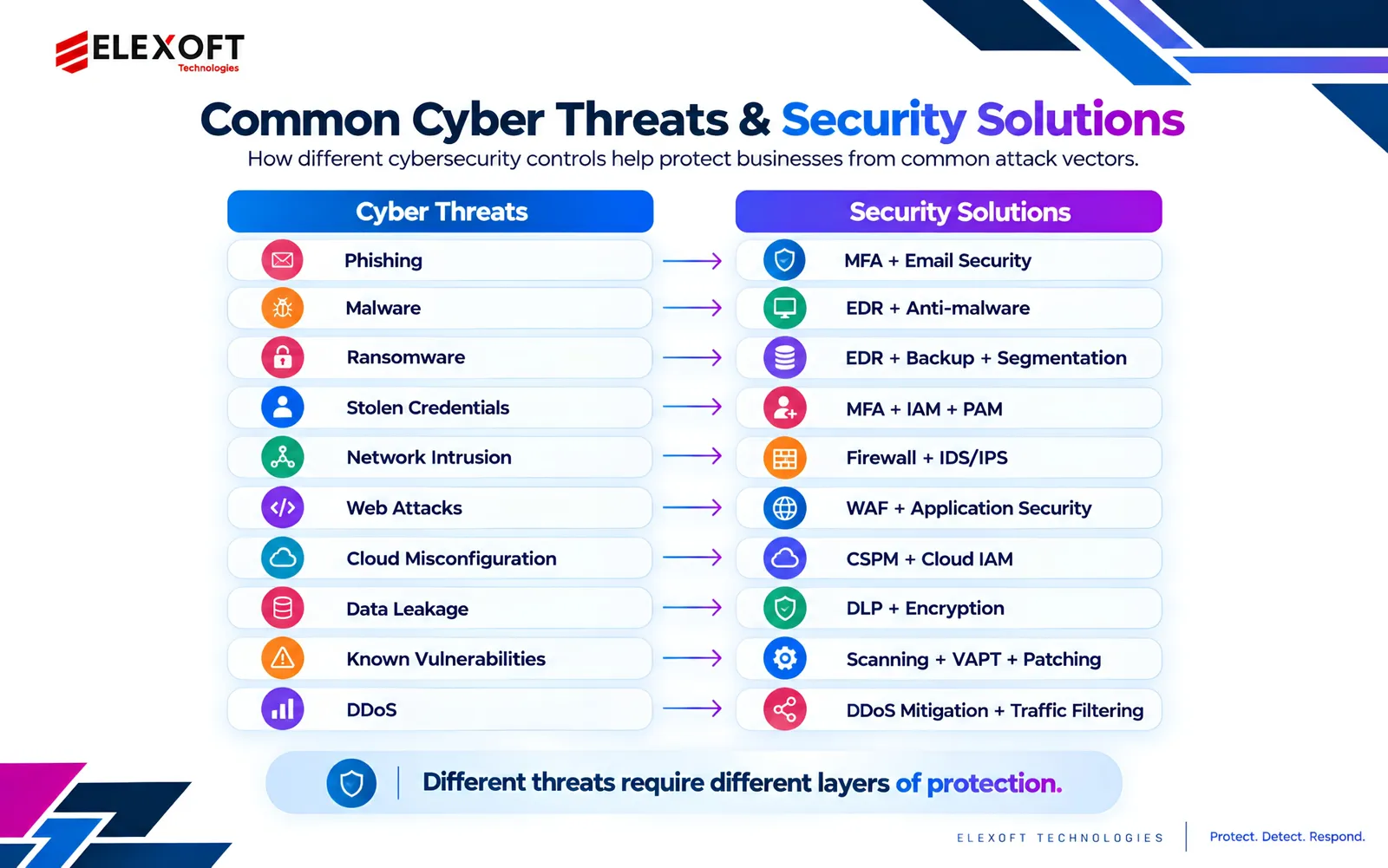
Choosing cybersecurity controls becomes easier when the organization starts with the threat or business risk rather than a list of available products.
1. Malware and Ransomware
Malware can enter through malicious files, compromised websites, software vulnerabilities, infected devices, stolen credentials, and other vectors.
Relevant defenses can include endpoint protection, EDR, email security, application control, patch management, segmentation, secure backups, and user awareness.
Ransomware resilience also requires recovery planning. Preventing an initial infection matters, but organizations should also plan how to restore key operations and data if preventive controls fail.
2. Phishing and Account Compromise
Phishing efforts to manipulate users into disclosing credentials, opening malicious files, authorizing fraudulent actions, or visiting deceptive websites.
Useful controls include:
- MFA
- Email filtering
- Security awareness training
- Conditional access
- Identity monitoring
- Strong authentication policies
- Privileged access controls
Technical controls and employee awareness complement each other.
3. Network Attacks
Unauthorized scanning, exploitation, lateral movement, interception, and denial of-service activity can target business networks.
Relevant network security solutions include firewalls, IDS/IPS, segmentation, secure remote access, network monitoring, and DDoS mitigation.
4. Application Vulnerabilities
Applications may contain weaknesses in authentication, authorization, input management, APIs, dependencies, business logic, or configuration.
Secure development, application security testing, code review, dependency management, penetration testing, WAFs, and runtime monitoring can provide complementary layers of defense.
5. Data Breaches
Data breaches can result from compromised credentials, vulnerable applications, excessive access, malware, misconfiguration, insider activity, or lost devices.
Organizations should combine access control, encryption, DLP, identity security, monitoring, secure application design, and data governance according to the sensitivity of the information involved.
6. DDoS Attacks
Distributed denial-of-service attacks attempt to overwhelm services or infrastructure with traffic or requests.
DDoS mitigation services, content distribution systems, traffic filtering, resilient architecture, rate limiting, and appropriate capacity planning can assist in maintaining service availability.
7. Insider and Privileged-Access Risks
Not every security risk originates outside the organization.
Employees, contractors, compromised accounts, or administrators may have legitimate access that they misuse intentionally or accidentally.
Least privilege, PAM, logging, access reviews, separation of duties, and anomaly detection can reduce these risks.
Cyber Security Solutions for Small Business
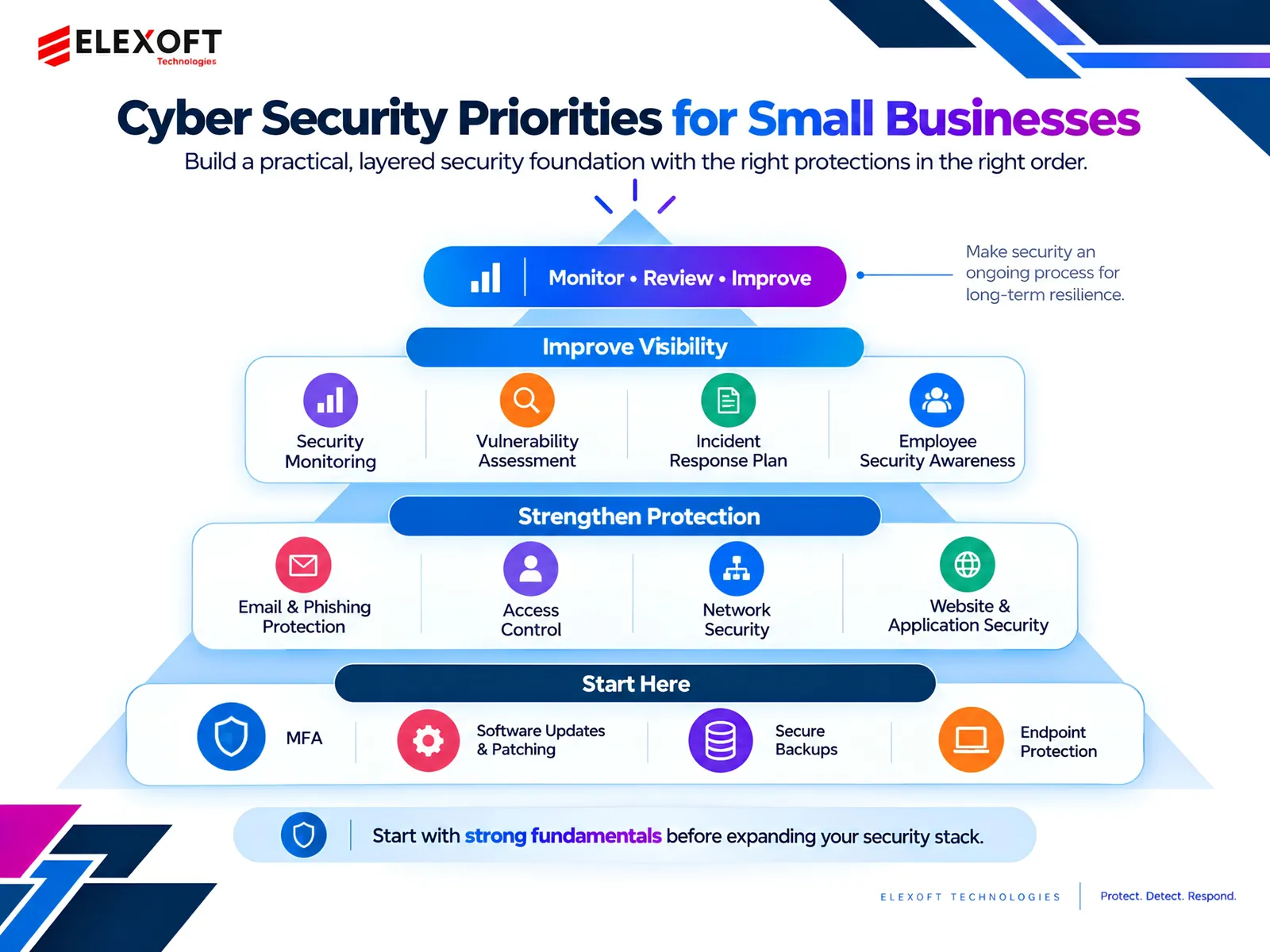
Small businesses need cybersecurity just as larger organizations do, but they usually have different budgets, staffing levels, infrastructure, and risk profiles.
That makes prioritization especially important.
NIST provides a dedicated Cybersecurity Framework 2.0 Small Business Quick-Start Guide for small and medium-sized organizations with modest or no existing cybersecurity plans. NIST emphasizes that the framework can be adapted to an organization’s own mission, resources, needs, and risks rather than applied as a one size fits all checklist.
Which Security Solutions Should Small Businesses Prioritize?
Small businesses should commence by identifying their most important systems, accounts, devices, applications, and data.
For many businesses, foundational priorities will include:
- Multi-factor authentication: Add additional authentication protection to important accounts, particularly administrative, email, cloud, financial, and remote access accounts.
- Endpoint protection: Protect employee devices and servers against malware and suspicious activity.
- Patch management: Keep operating systems, applications, plugins, and infrastructure components updated.
- Secure backups: Maintain reliable backups of important data and test restoration procedures.
- Email and phishing protection: Combine technical filtering with employee awareness.
- Access control: Remove unnecessary privileges and disable accounts that are no longer required.
- Network security: Protect internet facing infrastructure and restrict unnecessary connectivity.
- Application and website security: Keep web applications, CMS platforms, dependencies, APIs, and plugins secure and updated.
- Monitoring: Maintain enough logging and visibility to identify unusual activity.
The exact priority should depend on business risk. An ecommerce business processing customer transactions has different priorities from a small internal consultancy with limited public-facing infrastructure. That is why cyber security solutions for small businesses should be selected according to actual assets and risks rather than simply copying an enterprise security stack.
Cyber Security Solutions for Businesses in Pakistan
Organizations in Pakistan operate in the same interconnected digital environment as businesses elsewhere, while also needing to account for their local infrastructure, regulatory context, customers, workforce, and business operations.
The National Cyber Emergency Response Team of Pakistan (PKCERT) provides national cybersecurity advisories, technical resources, incident related information, awareness material, and other resources intended to strengthen Pakistan’s cyber ecosystem.
For Pakistani businesses, a practical cybersecurity strategy can include:
- Inventorying important digital assets.
- Protecting employee and administrator accounts.
- Securing websites, applications and APIs.
- Assessing network and cloud configurations.
- Maintaining endpoint security.
- Performing vulnerability assessments and appropriate testing.
- Maintaining backups and recovery procedures.
- Monitoring security events.
- Establishing an incident response process.
- Training employees to recognize common threats.
Businesses evaluating cyber security companies in Pakistan should look beyond a provider’s product list. More important questions include whether the provider understands the organization’s infrastructure, can explain the risks being addressed, can integrate controls alongside existing systems, and can define how the environment will be monitored and improved after implementation.
Benefits of Cyber Security Solutions
Cybersecurity is often discussed primarily in terms of preventing attacks, but its business value extends further.
1. Protection of Sensitive Data
Access controls, encryption, DLP, application security, and monitoring can help reduce the threat of unauthorized disclosure or modification of sensitive information.
2. Reduced Cyber Risk
Layered security makes it more difficult for a single weakness to lead directly to a major compromise.
For example, stolen credentials may be less useful when MFA is required, while segmentation may limit what a compromised endpoint can reach.
3. Improved Threat Visibility
Security monitoring, EDR, SIEM, cloud monitoring, and other detection technologies give organizations better visibility into events occurring across their environments.
Visibility is critical because a business cannot react appropriately to activity it cannot detect.
4. Faster Incident Response
Defined processes, centralized logs, automated workflows, and trained personnel can reduce confusion when suspicious activity is detected.
Organizations should know who investigates an alert, who can isolate affected systems, who communicates with stakeholders, and how recovery decisions are made.
5. Better Business Continuity
Cybersecurity and business continuity are closely connected.
Reliable backups, recovery plans, resilient infrastructure, incident response steps, and appropriate security controls help organizations prepare for interruptions and restore important operations.
6. Support for Compliance
Organizations may need to meet cybersecurity or privacy requirements arising from laws, industry standards, contracts, customer requirements, or internal governance.
Security technologies can support these requirements, but compliance and security are not synonymous. Passing a compliance assessment does not necessarily mean every relevant cyber risk has been addressed.
7. Greater Confidence in Digital Transformation
Organizations adopting cloud platforms, custom applications, automation, APIs, AI, and other digital technologies need security to progress alongside those systems.
Building security into architecture and development lets businesses modernize more deliberately, rather than treating security as an obstacle added after deployment.
How to Implement Cyber Security Solutions
Successful cybersecurity implementation starts with understanding the organization, not immediately purchasing technology.
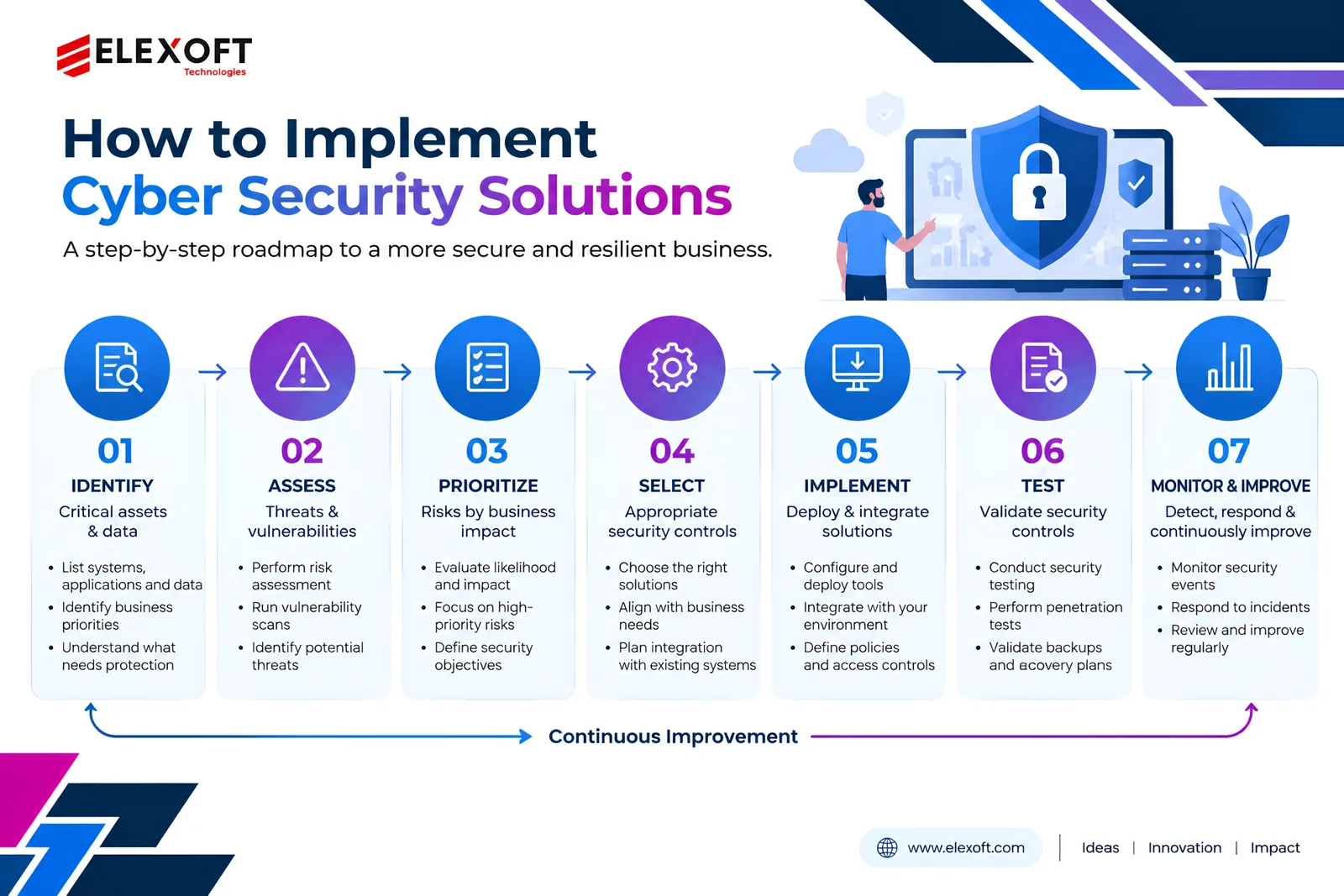
A structured implementation process can follow seven practical stages.
1. Identify Critical Assets and Data
Start by understanding what needs protection.
Create an inventory covering the following:
- Devices
- Servers
- Networks
- Applications
- Websites
- APIs
- Cloud resources
- User accounts
- Databases
- Sensitive information
- Third-party integrations
Then determine which assets are most important to business operations.
For example, an online retailer may give priority to its e-commerce platform, payment integrations, customer information, administrative accounts, order database, and cloud infrastructure.
2. Assess Threats and Vulnerabilities
Next, identify weaknesses and credible threat scenarios. This can involve vulnerability scanning, configuration reviews, application testing, access reviews, cloud assessments, network assessments, and penetration testing where appropriate.
The objective is not simply to generate a long list of vulnerabilities. Teams need to understand what each weakness means in context.
3. Prioritize Risks
Not every vulnerability deserves equal urgency.
Consider:
- Asset importance
- Data sensitivity
- Internet exposure
- Ease of exploitation
- Existing controls
- Potential business impact
- User privileges
- Dependencies
- Recovery capability
Risk-based prioritization prevents security teams from spending disproportionate resources on low impact issues while more important exposures remain unresolved. The NIST CSF 2.0 is useful here because it provides a common structure to understand and communicating cybersecurity outcomes without prescribing one specific set of technologies.
4. Select Appropriate Security Controls
Once risks are understood, map them to appropriate controls.
For example:
|
Stolen employee credentials |
MFA, conditional access, identity monitoring |
|
Malware on laptops |
EDR, patching, application control |
|
Exposed web application |
Secure development, WAF, testing |
|
Cloud misconfiguration |
CSPM, configuration policies, IAM |
|
Excessive administrator access |
PAM, least privilege, access reviews |
|
Sensitive data leakage |
DLP, encryption, access control |
|
Network lateral movement |
Segmentation, IDS/IPS, monitoring |
|
Unknown vulnerabilities |
Scanning, VAPT, patch management |
This risk-to-control mapping is more useful than buying products based solely on popularity.
5. Implement and Integrate Solutions
Security controls need to work with the organization’s existing technology.
Implementation may involve:
- Configuring access policies.
- Integrating identity providers.
- Deploying endpoint agents.
- Creating firewall rules.
- Connecting logs to monitoring systems.
- Configuring cloud policies.
- Updating software development pipelines.
- Defining alerts and escalation procedures.
- Establishing backup schedules.
- Training relevant employees.
Poorly configured security technology can create a false sense of protection, so deployment should include validation rather than stopping after installation.
6. Test Security Controls
After implementation, verify that controls actually work.
Testing may include:
- Vulnerability scans
- Penetration testing
- Access control testing
- Backup restoration tests
- Incident response exercises
- Application security testing
- Configuration reviews
- Alert validation
- Phishing simulations where appropriate
Testing should answer a simple question: Does the control reduce the risk it was implemented to address?
7. Monitor, Respond and Improve
Cybersecurity implementation is not a one time project.
Applications change. Employees join and leave. Infrastructure moves to the cloud. New vulnerabilities are discovered. Attack techniques evolve. Businesses add vendors and integrations.
Organizations therefore need an ongoing cycle of:
Monitor → Detect → Investigate → Respond → Recover → Review → Improve
NIST CSF 2.0 reflects this broader lifecycle through Govern, Identify, Protect, Detect, Respond, and Recover.
How to Choose the Right Cybersecurity Solutions
There is no universally correct security stack.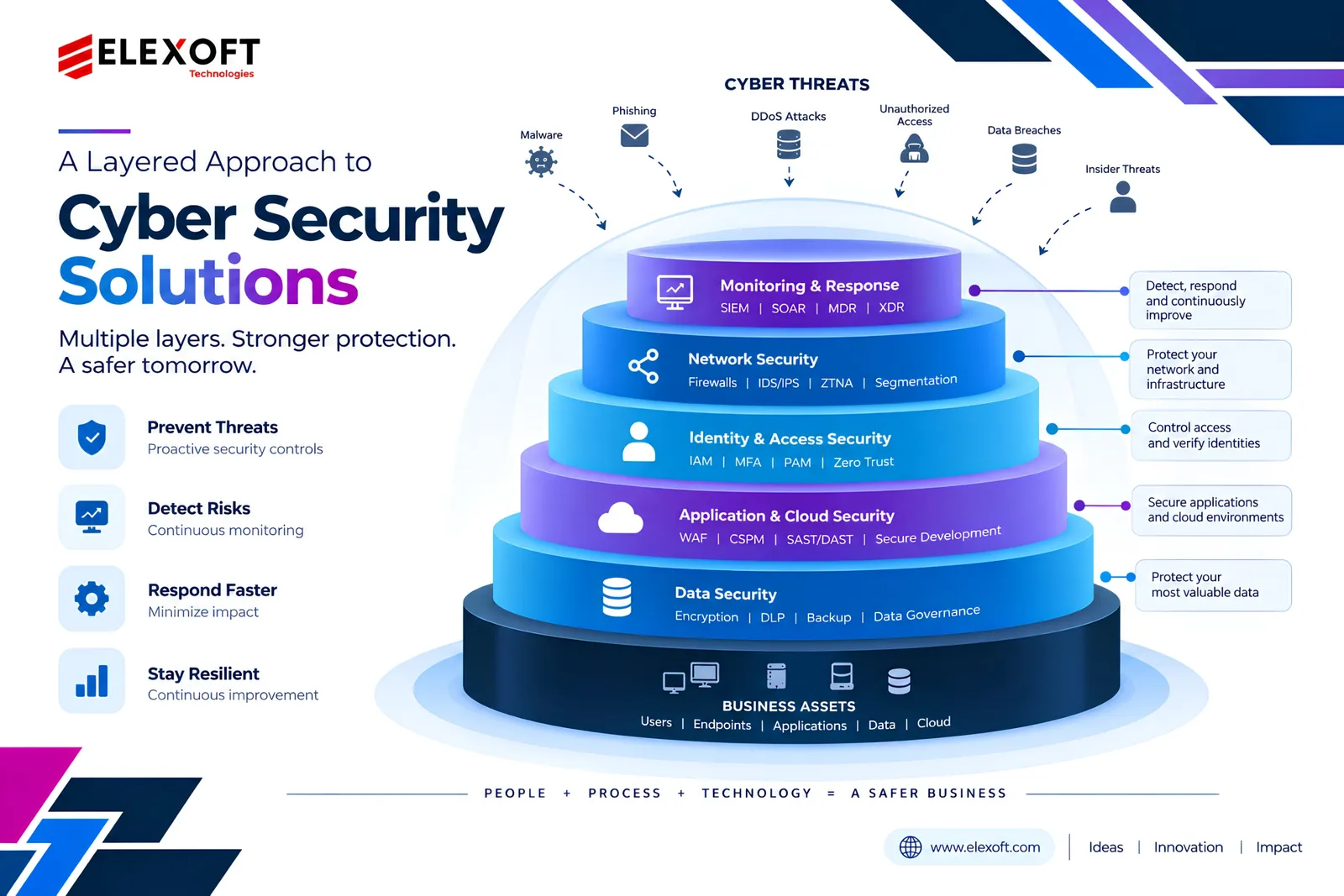
Organizations should evaluate security solutions against their own requirements.
1. Start With Risk, Not Features
A product with hundreds of security features provides little value if it doesn't address the organization’s most important risks.
Define the problem first.
2. Consider Your Technology Environment
Determine whether the solution supports your:
- Operating systems
- Cloud providers
- Applications
- Identity systems
- Existing security tools
- Remote workforce
- Network architecture
- Development environment
Integration can be just as important as individual product capability.
3. Evaluate Scalability
A solution that works for 20 users may not suit an organization expecting significant growth.
Consider how licensing, administration, logging, performance, and policy management change as the environment grows.
4. Consider Operational Requirements
Security tools generate work. Alerts need investigation. Policies need maintenance. Vulnerabilities require remediation. Logs require review. Incidents require response.
Before purchasing a platform, determine who will operate it.
5. Assess Usability
Security controls that make legitimate work unnecessarily difficult may encourage users to find workarounds.
Effective security should balance protection with operational usability.
6. Evaluate Vendor and Support Requirements
Consider documentation, update practices, support, integration options, security history, service availability, and contractual requirements.
7. Plan for Continuous Improvement
Choose solutions that support your broader security architecture rather than solving one isolated problem without considering future requirements.
In-House Cybersecurity vs Managed Cybersecurity Services
Organizations can operate cybersecurity internally, outsource selected functions, or use a hybrid model.
- An in-house approach delivers direct control and can build deep knowledge of the organization’s systems. However, it requires appropriate expertise, staffing, processes, tools, and ongoing training.
- A managed cybersecurity service can provide access to focused expertise and operational functions without building every function internally.
- A hybrid model combines both. Internal teams maintain ownership of strategy, risk, architecture, and business context as external specialists support functions for example monitoring, testing, incident response, or vulnerability management.
The right model depends on:
- Organization size
- Risk profile
- Internal expertise
- Budget
- Operating hours
- Technology complexity
- Regulatory obligations
- Required response capability
Outsourcing a function should always include clearly defined responsibilities and escalation procedures.
Common Cybersecurity Implementation Challenges
Even strong security technologies can fail to deliver expected results when implementation is poorly planned.
1. Lack of Asset Visibility
Organizations cannot secure systems they do not know exist.
Cloud resources, forgotten subdomains, old accounts, unmanaged devices, APIs, plus shadow IT can create blind spots.
2. Too Many Disconnected Tools
Adding more security products does not automatically improve security.
Disconnected tools can create duplicated alerts, disjointed data, operational complexity, and inconsistent policies.
3. Weak Identity Management
Excessive privileges, shared accounts, weak authentication, and old user accounts can undermine other security controls.
Identity security should be treated as a core part of the architecture.
4. Alert Fatigue
Security tools can generate large volumes of alerts.
Without appropriate tuning and prioritization, teams may spend too much time investigating low-value events while important activity is missed.
5. Limited Security Expertise
Some technologies require specialist knowledge to configure and operate effectively.
Organizations should account for operational expertise when choosing between internal management and managed services.
6. Treating Security as a One-Time Project
A security assessment represents conditions at a particular point in time. New vulnerabilities, configuration changes, software releases, new employees, new cloud services, and developing threats continually change the environment.
Security must therefore be maintained.
Cybersecurity Best Practices
Technology works best when supported by disciplined processes.
Organizations should establish several core practices.
- Maintain an accurate asset inventory. Know what devices, applications, cloud services, accounts, and data require protection.
- Use multi-factor authentication. Prioritize sensitive and privileged accounts.
- Apply least privilege. Give users and applications only the permissions they require.
- Keep software updated. Establish a repeatable process for identifying and applying security updates.
- Secure software from the beginning. Incorporate application security into requirements, design, development, testing, and deployment rather than depending solely on final-stage testing. OWASP specifically recommends integrating security activities throughout the SDLC.
- Protect and test backups. Recovery plans are only useful if restoration actually works.
- Segment important systems. Avoid unnecessary connectivity between environments.
- Centralize useful security visibility. Collect the logs and telemetry required to investigate suspicious events.
- Train employees. Users should understand phishing, credential security, suspicious requests, and internal reporting procedures.
- Prepare for incidents. Define roles, escalation procedures, communication paths, containment steps, and recovery processes before an incident occurs.
- Review controls regularly. Security architecture should progress alongside the business.
Building Secure Digital Solutions With Elexoft
Cybersecurity is closely connected to how digital systems are designed, developed, integrated, tested, and maintained.
Elexoft provides end-to-end software development services across web applications, mobile applications, AI solutions, CRM systems, enterprise integrations, and other digital products. Its services page specifically describes building secure, scalable, high-performance digital solutions and includes role-specific access control and security compliance among its CRM capabilities.
For web-based projects, Elexoft’s web development services include custom web applications, enterprise portals, ecommerce solutions, CMS development, APIs, and related development capabilities.
Businesses evaluating a new digital project should consider security requirements during architecture and development rather than waiting until the application has already been deployed.
This can involve defining authentication and authorization requirements, limiting unnecessary access, securing APIs, validating inputs, shielding sensitive data, reviewing dependencies, testing applications, and planning post-deployment maintenance.
You can also review Elexoft’s portfolio to explore examples of the company’s digital product work.
Frequently Asked Questions About Cyber Security Solutions
Cyber security solutions are technologies, processes, controls, and services used to protect networks, applications, endpoints, identities, cloud systems, and data against cyber threats. Examples include firewalls, EDR, MFA, IAM, SIEM, DLP, application security testing, cloud security tools, and managed security services.
2. What are the main types of cyber security solutions?
Major categories include network security, endpoint security, cloud security, application security, web security, data security, identity and access management, threat identification and response, vulnerability management, and managed cybersecurity services.
3. Why are cyber security solutions important?
Cyber security solutions help organizations reduce cyber risk, secure sensitive information, control access, detect suspicious activity, respond to incidents, maintain business continuity, and support applicable security and compliance requirements.
4. What are network security solutions?
Network security solutions protect network infrastructure and communications against unauthorized entry and malicious activity. Common examples include firewalls, IDS/IPS, network segmentation, secure remote access, network monitoring, and network access controls.
5. What are cloud security solutions?
Cloud security solutions protect cloud-hosted infrastructure, workloads, applications, identities, configurations, and data. Examples include CSPM, workload protection, cloud IAM, encryption, configuration monitoring, vulnerability management, and cloud threat detection.
6. What are application security solutions?
Application security solutions identify, prevent, and reduce software vulnerabilities. They can include secure coding, code review, static and dynamic testing, software composition analysis, API security, penetration testing, WAFs, and runtime monitoring.
7. What is CSPM?
CSPM stands for Cloud Security Posture Management. CSPM tools help organizations identify configuration issues, policy violations, and security weaknesses across cloud environments.
8. What is VAPT?
VAPT stands for Vulnerability Assessment and Penetration Testing. Vulnerability assessment identifies potential security weaknesses, while penetration testing uses controlled techniques to evaluate whether weaknesses can be exploited and what impact they may have.
9. What is an MSSP?
An MSSP is a Managed Security Service Provider. MSSPs provide outsourced cybersecurity capabilities including monitoring, security-device management, vulnerability management, incident support, or other managed security functions.
10. What is the difference between EDR and antivirus?
Conventional antivirus primarily focuses on identifying and blocking known malicious software. Endpoint Detection and Response delivers broader endpoint telemetry, behavioral detection, investigation, and response features.
11. What is the difference between IDS and IPS?
An Intrusion Detection System identifies potentially malicious network activity and generates alerts. An Intrusion Prevention System can also take automated action to block or prevent identified traffic according to configured policies.
12. What are the best cyber security solutions for small business?
There is no universal security stack for every small business. Common priorities include MFA, endpoint protection, patch management, secure backups, email security, access controls, network protection, website/application security, employee awareness, and appropriate monitoring. The final selection should reflect the business’s actual assets and risks.
13. How do I choose the right cyber security solution?
Start by recognizing critical assets, sensitive data, credible threats, vulnerabilities, existing controls, and potential business impact. Then select technologies and services that address the highest-priority risks as fitting your infrastructure, budget, expertise, and operational requirements.
14. How often should cybersecurity controls be reviewed?
Cybersecurity controls should be reviewed regularly and whenever meaningful changes occur, such as major software releases, infrastructure migrations, new cloud services, security incidents, significant vulnerabilities, new vendors, or changes to critical business systems. The appropriate review frequency depends on the organization’s risk and environment.
Conclusion
Cyber security solutions are most effective when they work as part of a coordinated risk-management strategy rather than as isolated products.
Network security solutions protect connectivity and infrastructure. Endpoint tools protect devices. Cloud security solutions address cloud workloads and configurations. Application security solutions reduce software risk. IAM and PAM control access. DLP protects sensitive information. EDR, XDR, SIEM, and SOAR improve detection and response. Vulnerability management and VAPT help identify weaknesses before they become larger problems.
But technology alone is not enough.
Businesses need to:
- Understand their assets
- Assess their risks
- Rank the most important exposures
- Implement appropriate controls
- Test those controls
- Monitor the environment
- Prepare for incidents
- Continuously improve
For small businesses, that often means starting with strong fundamentals rather than purchasing an enterprise-sized security stack.
For larger organizations, the challenge is frequently integration, visibility, governance, and operating security consistently across increasingly complicated environments.
The objective is ultimately the same:
Build security into the systems, applications, people, and processes the business depends on so that digital growth does not create unmanaged cyber risk.