


Enterprise IT Solutions: Benefits, Types & Best Practices
 Updated by James Smith
Enterprise IT solutions help organizations connect technology, business processes and data to improve efficiency, security, scalability and decision making. These solutions include enterprise software, cloud computing, IT infrastructure, cybersecurity, system integration, automation and application modernization.
However, adopting new technology does not automatically solve operational problems. Businesses need to choose solutions that meet their requirements, integrate with existing systems, and support long-term growth.
This guide examines the major types of enterprise IT solutions, their benefits, real world applications, implementation challenges, and best practices for choosing the right technologies.
What Are Enterprise IT Solutions?
Enterprise IT solutions combine software, infrastructure, cloud technologies, cybersecurity systems and professional IT services to support an organization's business operations.
Unlike standalone applications that handle individual tasks, enterprise solutions frequently connect multiple departments, systems, locations and workflows. Their primary purpose is to create a coordinated technology environment where information can move reliably between business functions.
For example, a distribution company may use enterprise resource planning (ERP) software for inventory and procurement, customer relationship management (CRM) software for sales and business intelligence tools for reporting.
When these systems are integrated, employees can access more consistent information, reduce repetitive work and make better operational decisions.
Enterprise IT solutions are not limited to large corporations. Small and medium-sized businesses could also benefit when their operations become too complex for disconnected software and manual processes.
1. Key Components of Enterprise IT Solutions
- Enterprise applications: Software that supports finance, customer management, inventory, procurement, human resources and other business functions.
- IT infrastructure: Servers, networks, storage systems, databases, and computing resources required to operate business applications.
- Cloud computing: Cloud based infrastructure, platforms, and software that support application hosting, storage, collaboration and expandability.
- System integration: Technologies that connect applications and enable information to move between different business systems.
- Cybersecurity: Security controls that protect business applications, networks, identities and sensitive information.
- IT management and support: Processes and services that help preserve system performance, availability and reliability.
Not every business requires every component. The right combination depends on business requirements, existing technology, budget, and future growth plans.
2. Enterprise IT Solutions vs. Enterprise IT Services
Enterprise IT solutions refer to the technologies and systems used to solve business problems. Enterprise IT services refer to the professional activities involved in designing, implementing, managing, securing and maintaining these technologies.
For example, an ERP platform is an enterprise IT solution, while ERP implementation, integration, consulting and ongoing technical support are enterprise IT services. Businesses may purchase existing software, develop custom applications, outsource technical services or combine these approaches.
Why Are Enterprise IT Solutions Important for Modern Businesses?
Modern businesses depend on multiple applications to manage customers, employees, transactions, operations and reporting. Problems arise when these applications cannot communicate effectively or respond to changing business requirements. Enterprise IT solutions tackle these challenges by improving the connection between business processes and supporting technologies.
Consider a retail company whose online store and warehouse system maintain separate inventory records. Customers may order products that are no longer available because the systems don't synchronize properly.Integrating these applications can reduce inventory variances and improve order processing.
Enterprise technology also plays an important role in digital transformation. Instead of simply replacing paper-based processes with digital tools, organizations can redesign workflows, improve access to information and create more consistent customer experiences.
The most effective IT investments begin with a clearly defined business problem, such as inaccurate reporting, delayed approvals, repeated data entry, high maintenance costs or limited scalability.
Types of Enterprise IT Solutions
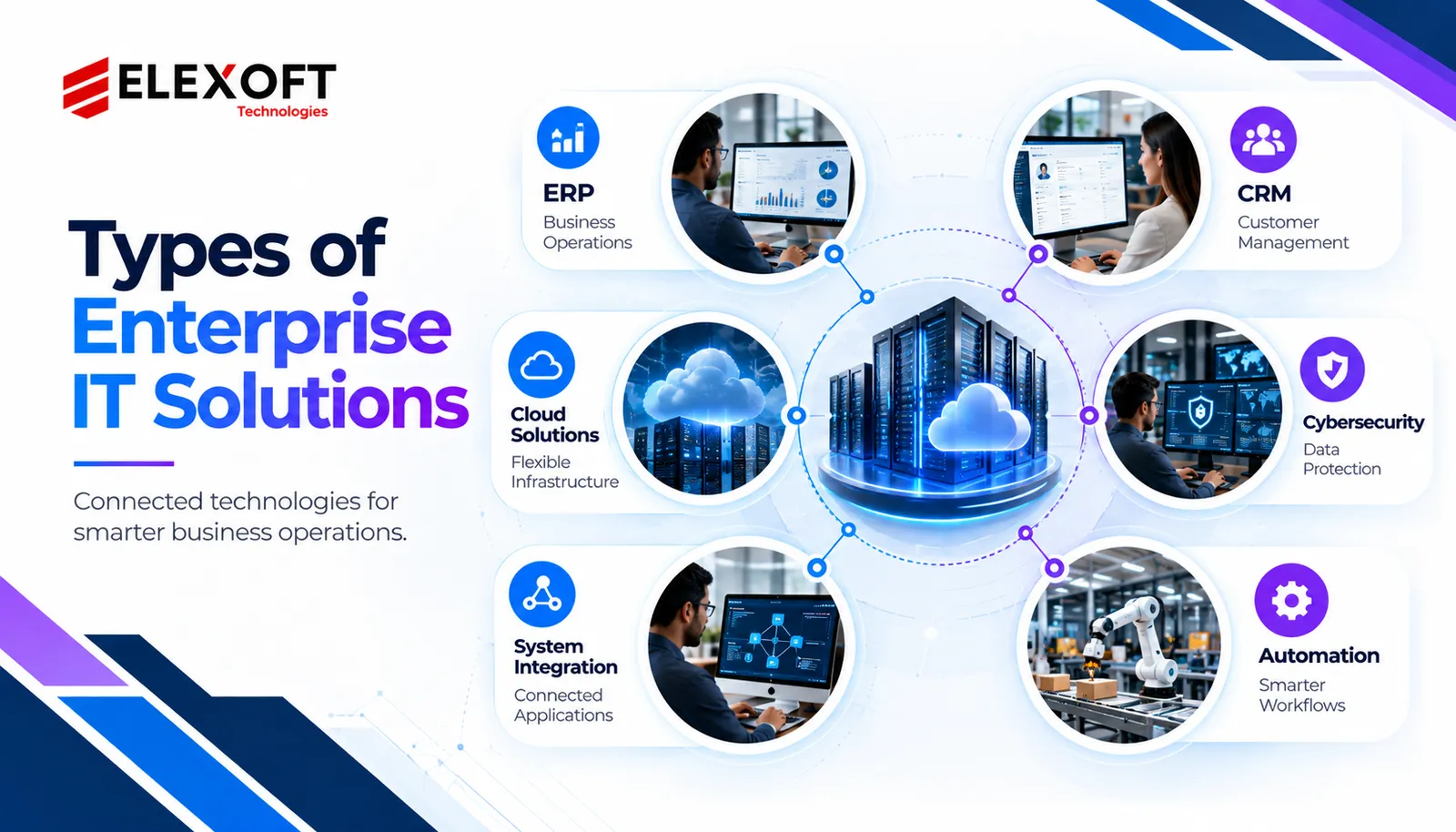
Enterprise IT solutions cover several technology categories. Knowing these categories helps businesses identify the systems that best match the company's operational requirements.
1. Enterprise Resource Planning (ERP) Solutions
Enterprise resource planning systems connect key business functions through a centralized, coordinated platform. ERP software commonly supports accounting, procurement, inventory management, manufacturing, supply chain activities, and human resources. For example, a manufacturing company may use ERP software to connect raw material purchasing with production schedules and finished-goods inventory.
This coordination can reduce duplicate records and improve cross department visibility. However, ERP implementation calls for careful planning. Before selecting or replacing a platform, evaluate present workflows, historical data, custom business rules and integration requirements.
2. Customer Relationship Management (CRM) Solutions
Customer relationship management systems organize customer information and support sales, marketing and customer service activities. CRM software may include lead management, sales pipelines, customer communications, support requests and account history.
When connected to other enterprise applications, CRM platforms can give employees a more complete view of customer activity.For example, integrating CRM and ERP software may allow sales representatives to view order status, payment information and product availability without contacting several departments.Successful integration necessitates clear rules for data ownership, synchronization and handling duplicate records.
3. Enterprise Cloud Solutions
Enterprise cloud solutions provide computing resources, storage, application platforms, and software through cloud environments.Cloud computing can help organizations deploy applications, support distributed teams, and adjust computing resources as business requirements change.
The three common cloud service models are:
- Infrastructure as a Service (IaaS): Provides virtual computing, networking, and storage resources.
- Platform as a Service (PaaS): Provides managed environments for developing and deploying applications.
- Software as a Service (SaaS): Delivers software applications through cloud-based services.
Organizations may use public, private, or hybrid cloud environments depending on their technical, security, and operational requirements. Cloud adoption may enhance flexibility, but it does not automatically reduce costs. Expenses depend on architecture, resource usage, storage, data transfer, and ongoing management.
4. Enterprise IT Infrastructure Solutions
Enterprise IT infrastructure provides the foundation required to run business applications and technology services.It includes servers, networking equipment, storage systems, databases, computing environments, and connectivity services.
Reliable infrastructure helps organizations maintain application performance, support employees, and deliver consistent services.For example, a business operating multiple branches may require secure connectivity between locations and reliable access to centralized applications. Infrastructure planning should consider performance, availability, scalability, maintenance, security, and disaster recovery requirements.
5. Enterprise Cybersecurity Solutions
Enterprise cybersecurity solutions protect business systems, networks, applications and information from security threats.
Common cybersecurity capabilities include:
- Identity and access management
- Multifactor authentication
- Endpoint protection
- Network security
- Data encryption
- Vulnerability management
- Security monitoring
- Incident response and recovery
Security is especially important when multiple enterprise applications exchange sensitive information. Organizations should establish appropriate access controls, monitor important systems, and regularly evaluate security risks. The NIST Cybersecurity Framework 2.0 delivers a structured approach to cybersecurity risk management through six functions: Govern, Identify, Protect, Detect, Respond and Recover.
No single cybersecurity product can eliminate every risk. Effective protection requires suitable technology, clear responsibilities, ongoing monitoring and tested recovery procedures.
6. Enterprise System Integration Services
System integration connects different applications, databases, and business processes so they can exchange information.
Businesses commonly integrate ERP, CRM, accounting, inventory, e-commerce, payment and reporting systems. Integration technologies may include application programming interfaces (APIs), middleware, integration platforms, event-driven messaging, and scheduled data transfers. For example, an e-commerce company may connect its online store with inventory management and accounting software.
When a customer places an order, the system can update relevant records and reduce manual data entry. However, integration requires more than establishing a connection. Businesses must also define data ownership, validation rules, synchronization frequency, error handling and monitoring.
7. Business Process Automation and AI Solutions
Business process automation uses software to complete repetitive tasks, coordinate workflows and reduce human involvement.
Common applications include invoice processing, approval workflows, report generation, customer notifications and data updates. Artificial intelligence can extend automation through document understanding, forecasting, classification, conversational interfaces and decision support. For example, an organization may automate regular invoice approvals while directing typical transactions to employees for review.
Not every business process requires artificial intelligence. Rule based automation may be more predictable and cost effective for simple tasks. Before implementing automation, businesses should evaluate process complexity, data requirements, exceptions, security and the need for manual supervision.
8. Managed IT Services
Managed IT services allow businesses to outsource defined technology management responsibilities to external specialists. Depending on the agreement, these services may include infrastructure monitoring, system maintenance, technical support, backup management, security operations and application support.
Managed services can help organizations access technical proficiency without maintaining every capability internally. However, service coverage varies by provider. Before selecting a provider, businesses should review service level agreements, response times, escalation procedures, exclusions, system ownership and ongoing support responsibilities.
9. Application Modernization and Legacy Systems
Application modernization improves existing software to meet changing business, security, performance, and integration requirements. Older applications may still support essential operations yet become difficult to maintain, scale, or integrate with modern systems.
Modernization approaches include:
- Rehosting: Moving an application to another hosting environment with limited changes.
- Replatforming: Making targeted platform upgrades without completely rebuilding the application.
- Refactoring: Improving existing code or architecture while preserving important functionality.
- Rebuilding: Developing a new application to replace an obsolete system.
- Replacing: Adopting a different platform or product that meets business requirements.
The best approach depends on technical debt, maintenance costs, system dependencies, business criticality, and implementation risks. Organizations can also refer to AWS guidance on application migration strategies when evaluating different approaches to legacy system modernization.
Key Benefits of Enterprise IT Solutions
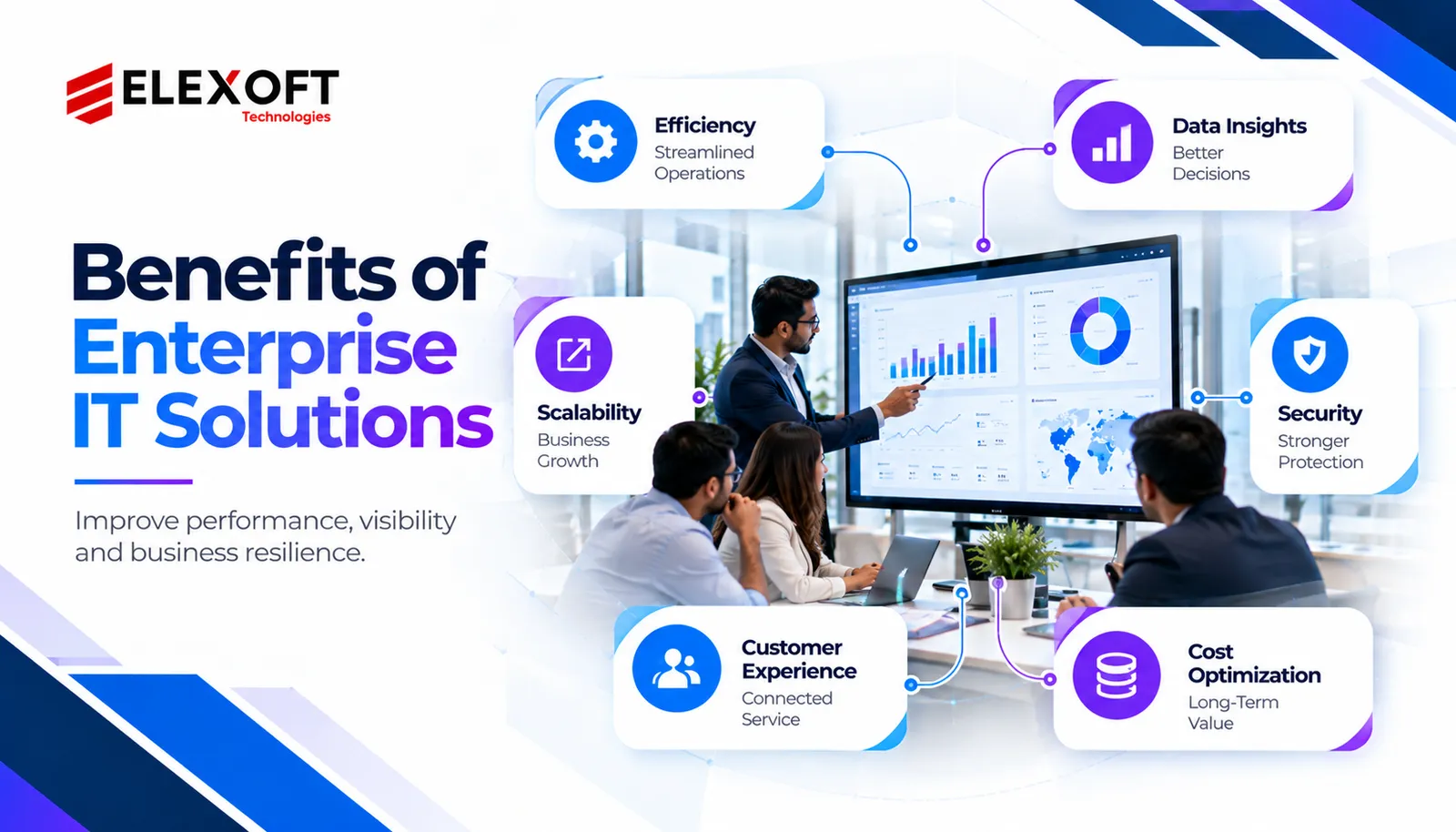
Enterprise IT solutions can deliver several business advantages when they are selected and implemented around clearly defined requirements.
Improved Business Efficiency
Integrated applications reduce the need for employees to enter the same information into multiple systems. Automation can also reduce repetitive administrative tasks and unnecessary approval delays.
For example, connecting sales, inventory, and accounting systems may allow order information to move between departments without repeated manual updates. Firms can measure improvements through processing time, error rates, and the number of manual steps eliminated.
Better Data Management and Decision Making
Enterprise applications can bring information from different departments into a more consistent reporting environment. Managers may use connected sales, inventory, and financial data to understand business performance and identify operational problems.
However, accurate reporting depends on reliable data. Integrating outdated or inconsistent records does not automatically enhance decision making. Data quality and governance remain essential.
Greater Scalability and Flexibility
Scalable technology permits businesses to support additional users, transactions, locations, and services without repeatedly rebuilding their systems.
Cloud environments, modular applications, and well designed integrations can support business expansion. Organizations should evaluate scalability against realistic growth scenarios and expected workloads.
Stronger Security and Business Continuity
Enterprise technology can support improved access controls, monitoring, backup procedures, and restoration capabilities. Business continuity planning helps organizations prepare for disruptions, while disaster recovery focuses on restoring affected systems and data.
When properly implemented, maintained and tested, these measures can improve institutional resilience.
Improved Customer Experience
Connected systems help employees access relevant information and respond more consistently to customer requests. For example, customer support teams can review order history, shipment progress, and previous interactions from connected business applications.
This can reduce delays caused by disconnected systems and incomplete information.
Long Term Cost Optimization
Enterprise IT solutions can reduce certain operating costs through automation, system consolidation, and more productive resource utilization. However, businesses must consider implementation, licensing, infrastructure, integration, training and maintenance expenses.
The objective should be long term value rather than simply selecting the lowest cost technology.
Real Life Applications of Enterprise IT Solutions
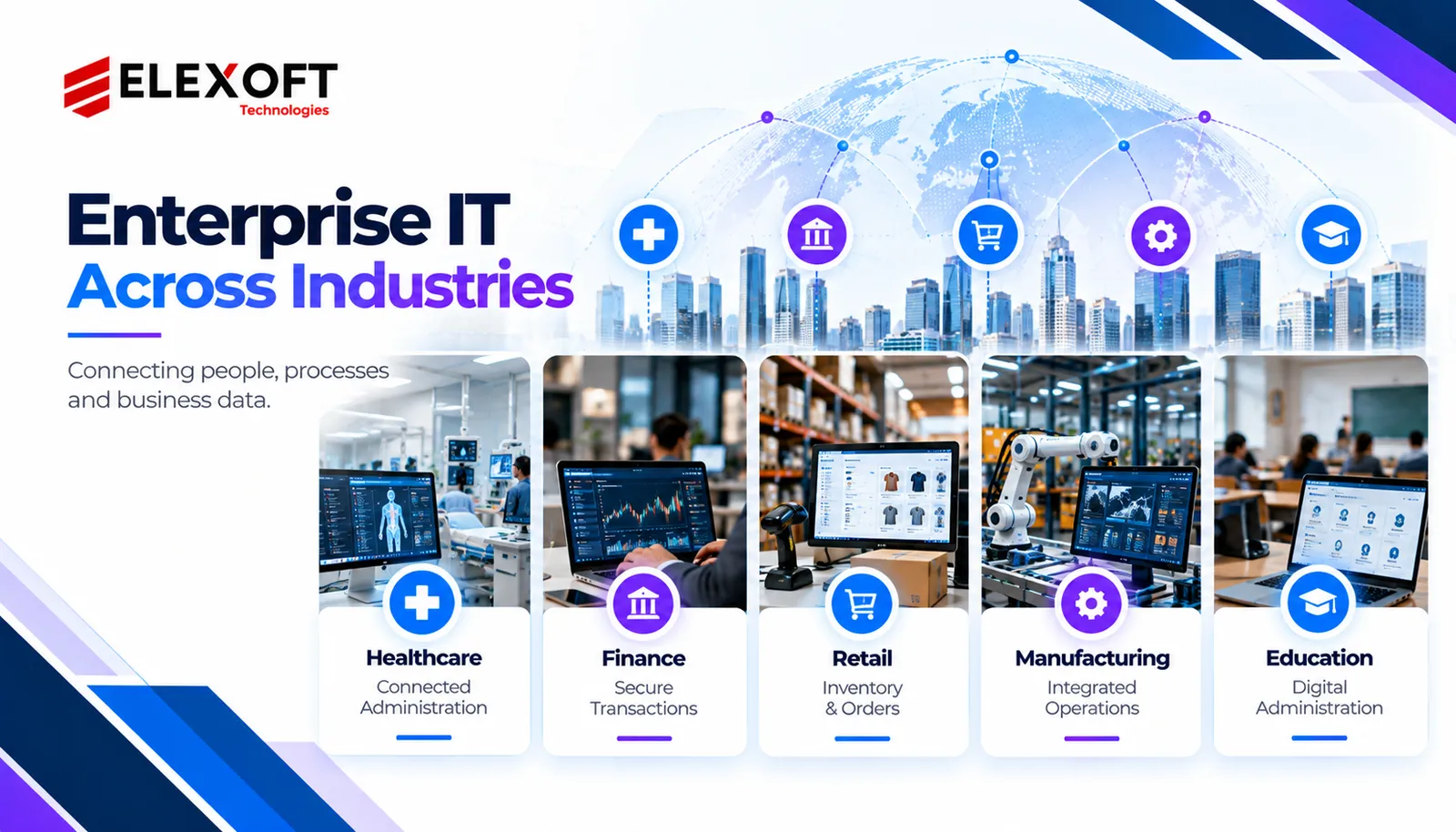
Enterprise technology supports different industries via addressing their operational level and information management requirements.
Healthcare
Healthcare organizations may use connected scheduling, patient administration, billing, reporting and communication systems. Appropriate privacy safeguards and access controls remain essential when these applications process sensitive information.
Integrating administrative systems can reduce repeated data entry and improve coordination between departments.
Finance and Banking
Finance and banking organizations depend on secure transactions, reliable records, controlled workflows, and accurate reporting. Enterprise applications may support customer management, approvals, monetary operations, compliance activities and audit trails.
Automation can assist with routine processing, while human monitoring remains important for sensitive decisions.
Retail and E-commerce
Retail and E-commerce firms can connect online stores, inventory systems, customer records, payment processing and fulfillment operations.
Integrated systems can reduce inventory variances and improve visibility regarding customer orders.
Manufacturing and Logistics
Manufacturing and logistics companies may use ERP, warehouse management, procurement, fleet management and analytics platforms.
Connecting these applications can improve visibility into materials, production schedules, orders and deliveries.
Education and Professional Services
Educational institutions and service businesses may use integrated registration, scheduling, payment, communication and reporting systems.
These solutions can simplify administrative workflows and improve the consistency of business records.
How to Choose the Right Enterprise IT Solutions
Selecting enterprise technology should begin with identifying SDLC operational problems and business objectives. A company struggling with inaccurate inventory information may need better system integration before investing in a completely new ERP platform.
Similarly, an organization experiencing slow application performance should determine whether the problem comes from software architecture, infrastructure capacity, database performance or another dependency.
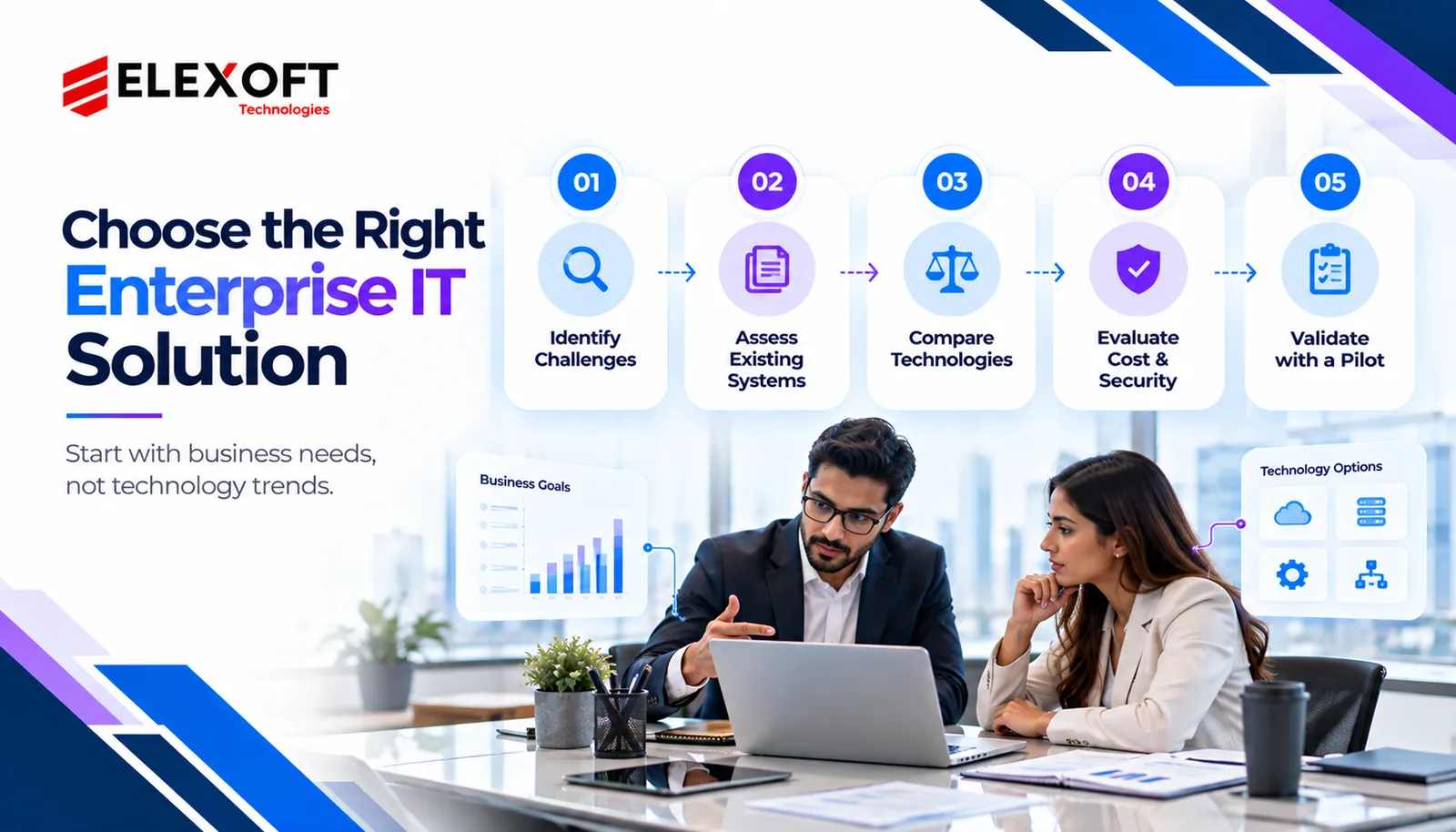
The following comparison connects common business challenges with potential technology solutions.
|
Business Challenge |
Enterprise IT Solution |
Key Consideration |
|
Disconnected business data |
ERP/CRM integration |
Data synchronization and ownership |
|
Outdated internal applications |
Application modernization |
Migration risk and compatibility |
|
Repetitive manual processes |
Business process automation |
Exceptions and approval controls |
|
Inaccurate reporting |
Data integration and analytics |
Data quality |
|
Limited application scalability |
Cloud or infrastructure modernization |
Architecture and ongoing costs |
|
Security vulnerabilities |
Cybersecurity assessment and controls |
Governance and risk management |
|
Limited internal IT resources |
Managed IT services |
Support scope and accountability |
Businesses should compare available options based on implementation effort, security requirements, compatibility, scalability, long-term costs, and expected business value.
A pilot project or proof of concept can help validate important assumptions before a larger implementation.
Common Difficulties in Implementing Enterprise IT Solutions
Enterprise IT projects change technology, workflows, data, and employee responsibilities.
Comprehending common challenges can help businesses plan more effectively.
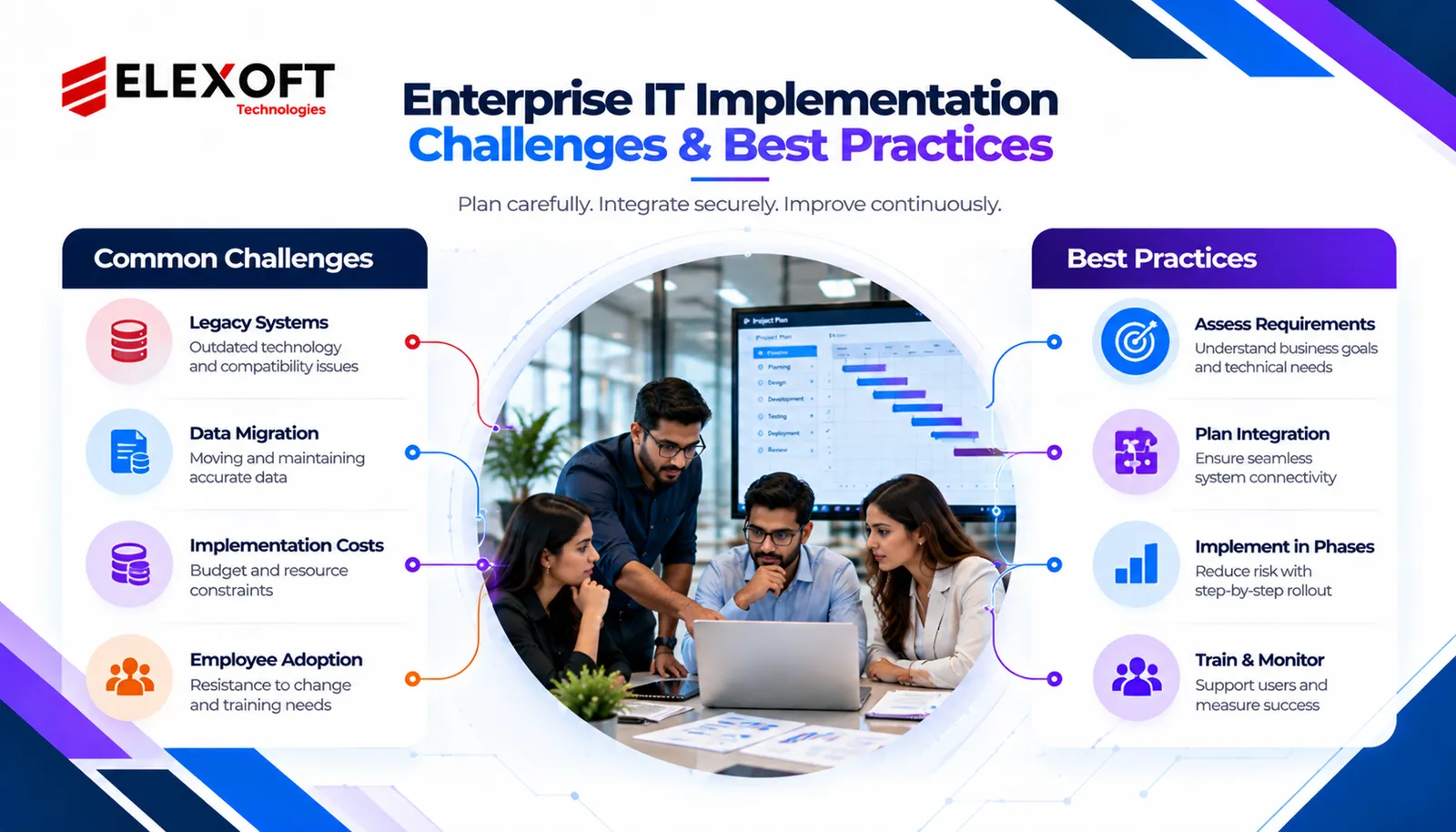
Legacy System Integration
Older applications may use outdated technologies, undocumented data structures or custom business rules.
Replacing these systems without understanding their dependencies can disrupt critical operations.
Businesses should document present workflows, integrations, data exchanges and operational requirements before modernization.
Data Migration and Quality
Business data may contain duplicate, incomplete, outdated or inconsistent records.
Moving poor quality information into a new platform can preserve existing problems.
A migration strategy should include data cleansing, validation, reconciliation, ownership and recovery procedures.
Implementation Costs
Enterprise technology projects frequently involve expenses beyond software licensing or initial development.
Integration, infrastructure, migration, employee training, security, testing and ongoing support can affect the total budget.
Organizations should request estimates that clearly explain assumptions, dependencies, exclusions and potential additional expenses.
Employee Adoption and Change Management
Employees may depend on proven workflows and familiar applications.
A new system may satisfy technical criteria but fail to improve daily operations if users cannot work with it effectively.
Early employee involvement, realistic testing, explicit communication and role specific training can improve adoption
Security and Compliance
Enterprise systems may process sensitive customer, employee, financial, and operational information.
Businesses need to evaluate applicable legal obligations, contractual requirements, access permissions, data protection and third party responsibilities.
Consider security during planning and architecture rather than adding it after deployment.
Vendor Dependence
Organizations may become dependent on vendors for application updates, integrations, hosting, or technical support.
Before choosing a platform, businesses should examine documentation, data portability, API access, licensing restrictions and support arrangements.
Clear technical ownership helps reduce long term operational risk.
Best Practices for Implementing Enterprise IT Solutions
Successful enterprise IT implementation calls for a formal approach that connects business requirements with technical decisions.
1. Assess Existing Systems and Business Requirements
Commence by reviewing the organization's current technology environment.
Identify important applications, infrastructure, integrations, data sources, users and operational limitations.
Speak with employees who use these systems regularly. Their experience can reveal workflow problems and dependencies that may not appear in technical documentation.
2. Determine Clear Business Objectives
Establish measurable goals before selecting technologies.
Instead of attempting to improve efficiency generally, identify specific outcomes such as decreasing manual reconciliation, shortening approval cycles or improving inventory accuracy.
Document current performance so improvements can be evaluated after implementation.
3. Develop an Enterprise IT Strategy
Create a technology roadmap aligned with business priorities, budget, resources and implementation risks.
Decide which systems to retain, integrate, modernize or replace.
Prioritize improvements based on business value and operational urgency.
4. Select Scalable and Secure Technologies
Evaluate potential technologies based on architecture, integration features, security controls, reliability, support and future requirements.
A platform with extensive features may still be unsuitable if it cannot work effectively with existing business systems.
Use pragmatic scenarios and demonstrations to assess suitability.
5. Plan Integration and Data Migration
Identify integration and migration requirements early.
Define source systems, destination systems, data ownership, synchronization rules, validation procedures and error handling.
For critical processes, include monitoring, reconciliation, recovery procedures and appropriate testing.
6. Give priority to Security and Governance
Establish appropriate access permissions, authentication controls, logging, data protection and operational responsibilities.
Define who approves changes, manages incidents and maintains shared systems.
Security and governance should continue after deployment.
7. Implement Solutions in Phases
A staged implementation can reduce disruption and make problems easier to identify.
Start with a clearly defined business capability, validate the results and expand when the organization is ready.
Testing should cover normal workflows, exceptions, integrations, performance, permissions and recovery scenarios.
8. Train Employees and Monitor Performance
Provide training based on employees' actual responsibilities.
After deployment, monitor adoption, application performance, error rates and business KPIs.
Continue improving the technology environment as requirements change.
How Much Do Enterprise IT Solutions Cost?
The cost of enterprise IT solutions depends on the technologies selected, number of users, existing infrastructure, integration requirements, security needs, and level of customization.
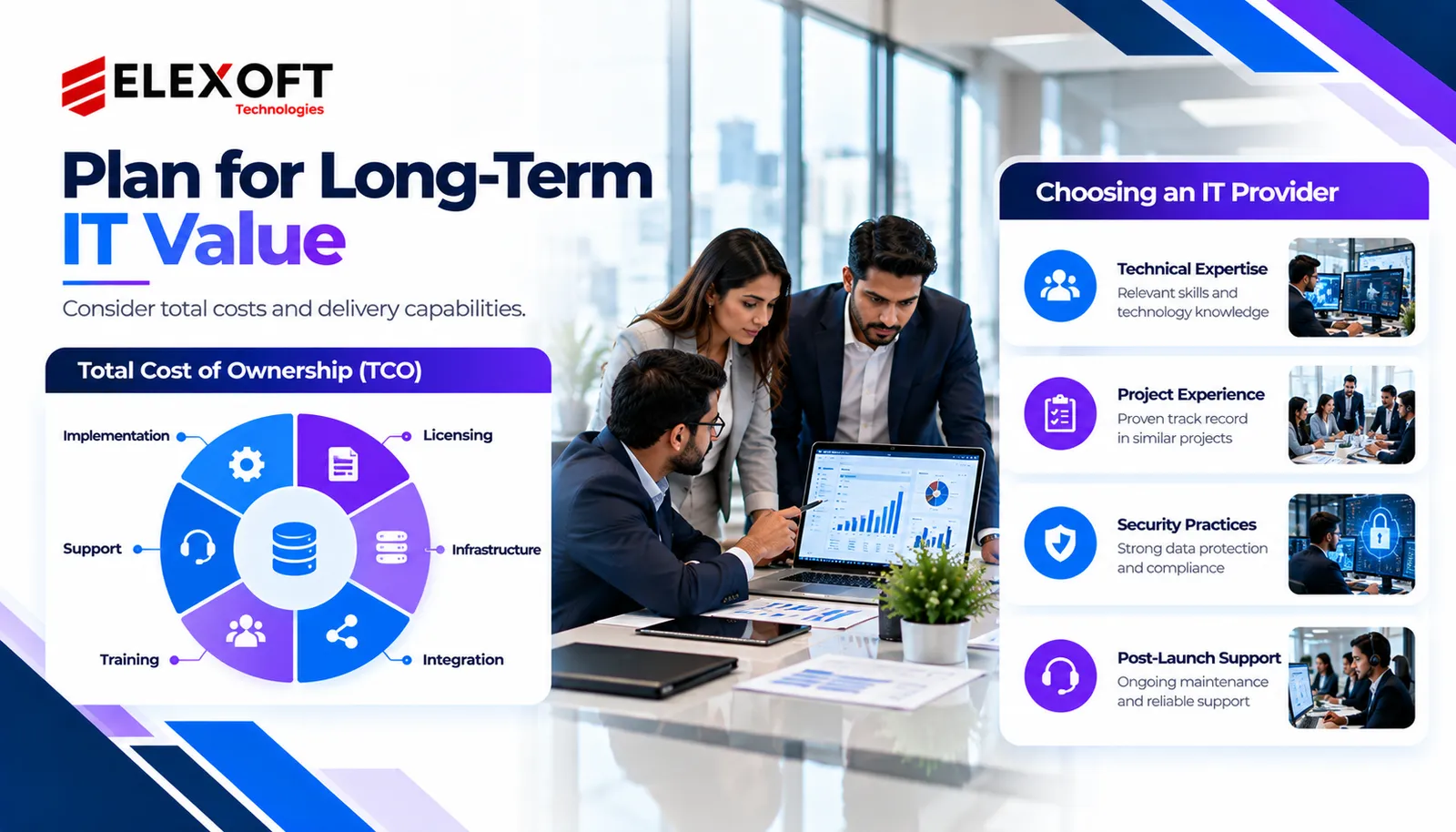
An existing cloud application may follow a subscription pricing model, while custom enterprise software may require discovery, design, development, testing, deployment, and ongoing maintenance.
Businesses should evaluate the total cost of ownership (TCO) rather than focusing only on initial implementation expenses.
A simplified calculation is:
Total Cost of Ownership = Implementation + Licensing + Infrastructure + Integration + Training + Support + Expected Upgrade Costs
Additional considerations may include migration effort, internal staff time, and business disruption.
For example, a low-cost application that requires employees to perform extensive manual reconciliation may become more expensive to operate than a better-integrated alternative.
When reviewing vendor proposals, organizations should ask for clear information about included services, ongoing charges, third-party costs, exclusions, and assumptions that may affect the final estimate.
The best solution meets key business requirements at an acceptable long-term cost and risk level.
How to Choose the Right Enterprise IT Solutions Provider
Choosing an enterprise technology provider requires more than comparing prices or reviewing a list of technical services. Businesses should evaluate whether a provider understands their business challenges and can deliver appropriate solutions.
Important considerations include:
- Technical expertise: Experience with relevant applications, platforms, integrations, and development technologies.
- Project experience: Evidence of work involving comparable technical challenges as well as business requirements.
- Implementation approach: Clear processes for discovery, planning, development, testing, deployment and support.
- Security practices: Appropriate consideration of data protection, access controls and system dependability.
- Communication: Open reporting, defined responsibilities and clear project expectations.
- Pricing transparency: Understandable estimates, exclusions and change management procedures.
- Post launch support: Defined maintenance responsibilities, documentation and support arrangements.
Businesses should also distinguish between project-based software development and ongoing managed IT operations. A provider experienced in enterprise application development may not necessarily offer full infrastructure monitoring or managed cybersecurity services. Before selecting a provider, request a practical explanation of how the proposed solution will integrate with current systems and how its success will be measured.
Future Trends in Enterprise IT Solutions
Enterprise technology continues to evolve as businesses seek more efficient, adaptable and secure systems.
Several developments are determining how organizations plan future technology investments.
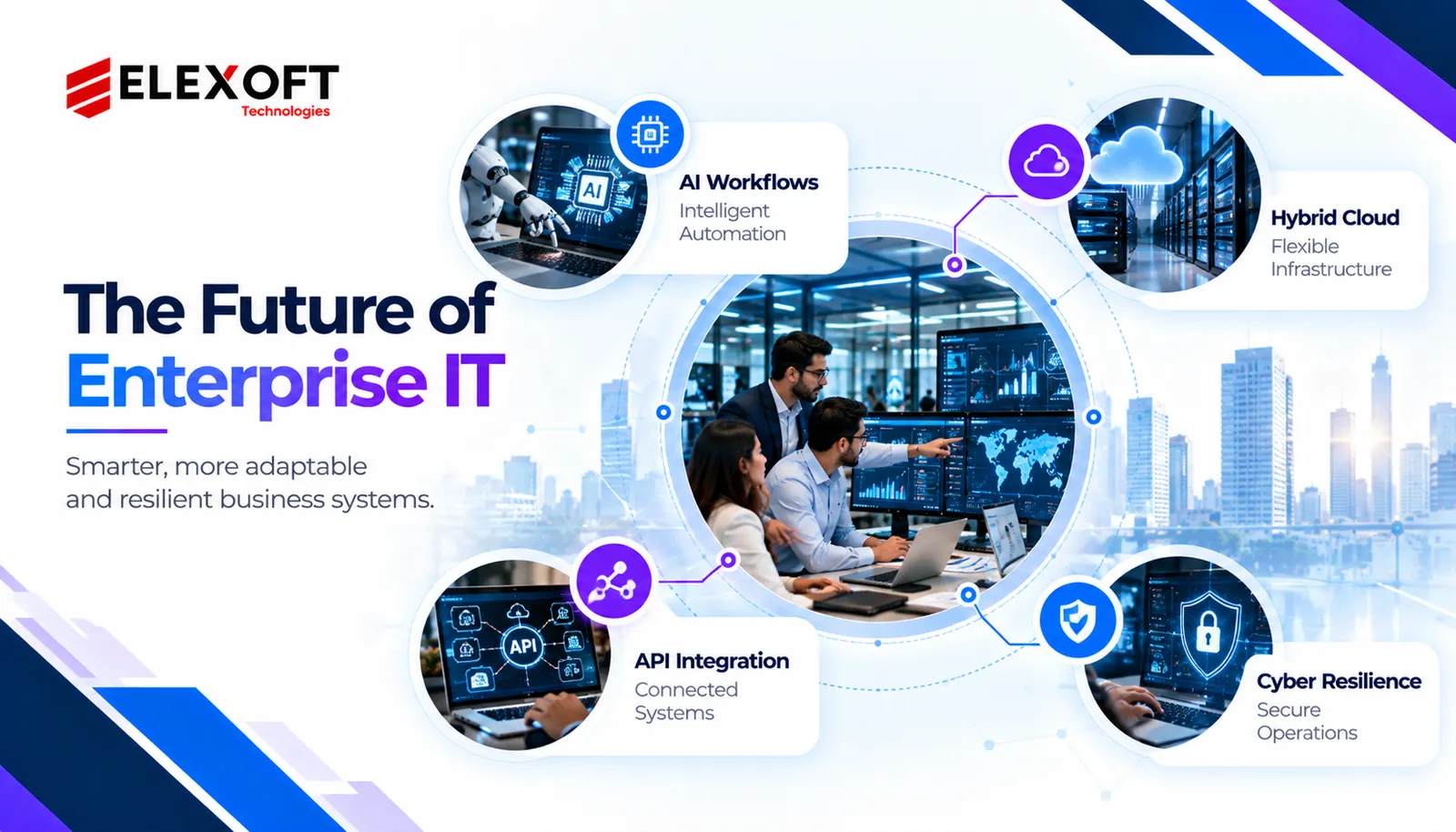
AI-Enabled Enterprise Workflows
Artificial intelligence can support document processing, forecasting, customer service, knowledge retrieval and operational decision making.
However, AI systems require reliable data, appropriate safeguards, clear evaluation criteria and human monitoring.
Organizations ought to prioritize practical business value rather than adopting AI simply because it is available.
Hybrid Cloud and Application Modernization
Many businesses operate a combination of cloud services and existing infrastructure.
Hybrid environments can help organizations modernize selected systems whilst maintaining applications that cannot easily be moved.
Application modernization also lets businesses improve existing software without replacing every component.
API-Driven and Event Based Integration
Modern integration architectures increasingly use APIs and event driven approaches to coordinate information between applications.
With clear data contracts, monitoring, validation, and error handling procedures, these technologies can improve flexibility.
Security and Business Resilience
Security, identity management, data protection and recovery planning remain important parts of enterprise technology strategy.
Organizations must assess risks across applications, integrations, cloud resources, vendors and operational processes.
The most valuable technology developments help businesses build reliable, maintainable and adaptable systems.
Frequently Asked Questions About Enterprise IT Solutions
1. What are enterprise IT solutions?
Enterprise IT solutions combine software, infrastructure, cloud services, cybersecurity, integration technologies and IT management capabilities to support business operations. They help organizations connect systems, manage information, automate operations and improve technology dependability.
2. What are the main types of enterprise IT solutions?
The main types include ERP, CRM, enterprise cloud computing, IT infrastructure, cybersecurity, system integration, business process automation, managed IT service and application modernization. Businesses choose these technologies based on their business requirements.
3. What are the benefits of enterprise IT solutions?
Enterprise IT solutions can improve operational efficiency, data visibility, scalability, collaboration, security and business continuity. Actual results depend on technology selection, implementation quality and alignment with business objectives.
4. What is the difference between enterprise IT solutions and enterprise IT services?
Enterprise IT solutions are the technologies and systems used to address business requirements. Enterprise IT services involve planning, developing, integrating, operating, maintaining or supporting those solutions.
5. How much do enterprise IT solutions cost?
Costs depend on software licensing, customization, infrastructure, integration, migration, training and ongoing support. Businesses should evaluate total cost of ownership rather than considering only initial implementation expenses.
6. How long does enterprise IT implementation take?
Implementation timelines depend on project scope, system complexity, data migration, integration requirements, available resources and organizational readiness. A detailed assessment is usually required to estimate a realistic timeline.
7. Can enterprise IT solutions integrate with existing software?
Many enterprise IT solutions can integrate with existing applications through APIs, middleware, data pipelines or custom interfaces. Integration feasibility depends on system capabilities, data quality, security requirements and technical limitations.
8.How do businesses choose the right enterprise IT solutions provider?
Businesses should evaluate technical expertise, relevant project experience, integration capabilities, security practices, delivery processes, pricing transparency and post launch support. The provider should demonstrate how its proposed solution addresses specific business requirements.
Conclusion: Building a Stronger Business With Enterprise IT Solutions
Enterprise IT solutions help organizations connect business systems, modernize applications, improve operational efficiency, and create a more reliable technology foundation.
However, successful implementation requires more than selecting modern software. Businesses must consider existing processes, integration requirements, data quality, security, employee adoption and long term costs. The most effective approach begins with identifying business challenges, evaluating current systems, comparing suitable technologies, and establishing measurable objectives. For organizations exploring custom software, enterprise application integration, modernization or AI-enabled workflows, Elexoft offers software development and digital solution capabilities.